Losing a single tooth can raise a lot of practical questions quickly. Will the gap affect chewing? Will neighboring teeth shift? What is the most durable option?
For many people researching cost in NYC, the decision often comes down to two common permanent solutions: a single dental implant or a dental bridge.
Both treatments can restore function and improve appearance, but they work differently and have different long term implications for the teeth around the gap. The right choice depends on your oral health, bone support, budget, timeline, and personal treatment goals. If you are comparing tooth replacement options in New York City, understanding the differences before you schedule a consultation can make the process much easier.
What Is a Single Tooth Implant?
A single tooth implant replaces the missing tooth root as well as the visible crown. The treatment usually involves three parts: a titanium implant placed in the jawbone, an abutment that connects the implant to the restoration, and a crown that looks like a natural tooth.
Because the implant is anchored in the bone, it functions independently from the neighboring teeth. That is one reason many patients view it as a highly stable, long term solution for replacing one missing tooth.
A dental implant may be a good option for patients who have:
- Healthy gums
- Enough jawbone to support placement, or the ability to rebuild bone if needed
- Good oral hygiene habits
- No untreated gum disease or active infection
Healing is important. After placement, the implant needs time to integrate with the bone, a process called osseointegration. That is what gives implants their strength, but it also means treatment takes longer than a bridge.
What Is a Dental Bridge?
A dental bridge fills the gap left by one missing tooth by using the teeth next to the space as support. Those neighboring teeth are typically shaped for crowns, and the replacement tooth, called a pontic, is suspended between them.
Bridges can be an effective way to restore appearance and chewing function, especially when treatment needs to move faster. For some patients, a bridge is also the better option if the adjacent teeth already need crowns.
A bridge may be appropriate when:
- The teeth on both sides of the gap are strong enough to support crowns
- The patient wants a faster restoration
- Bone loss or medical factors make implant placement less suitable
- The surrounding teeth already need treatment
A bridge does not replace the tooth root, so the jawbone under the missing tooth does not receive stimulation in the same way it would with an implant. That is an important difference to discuss with your dentist.
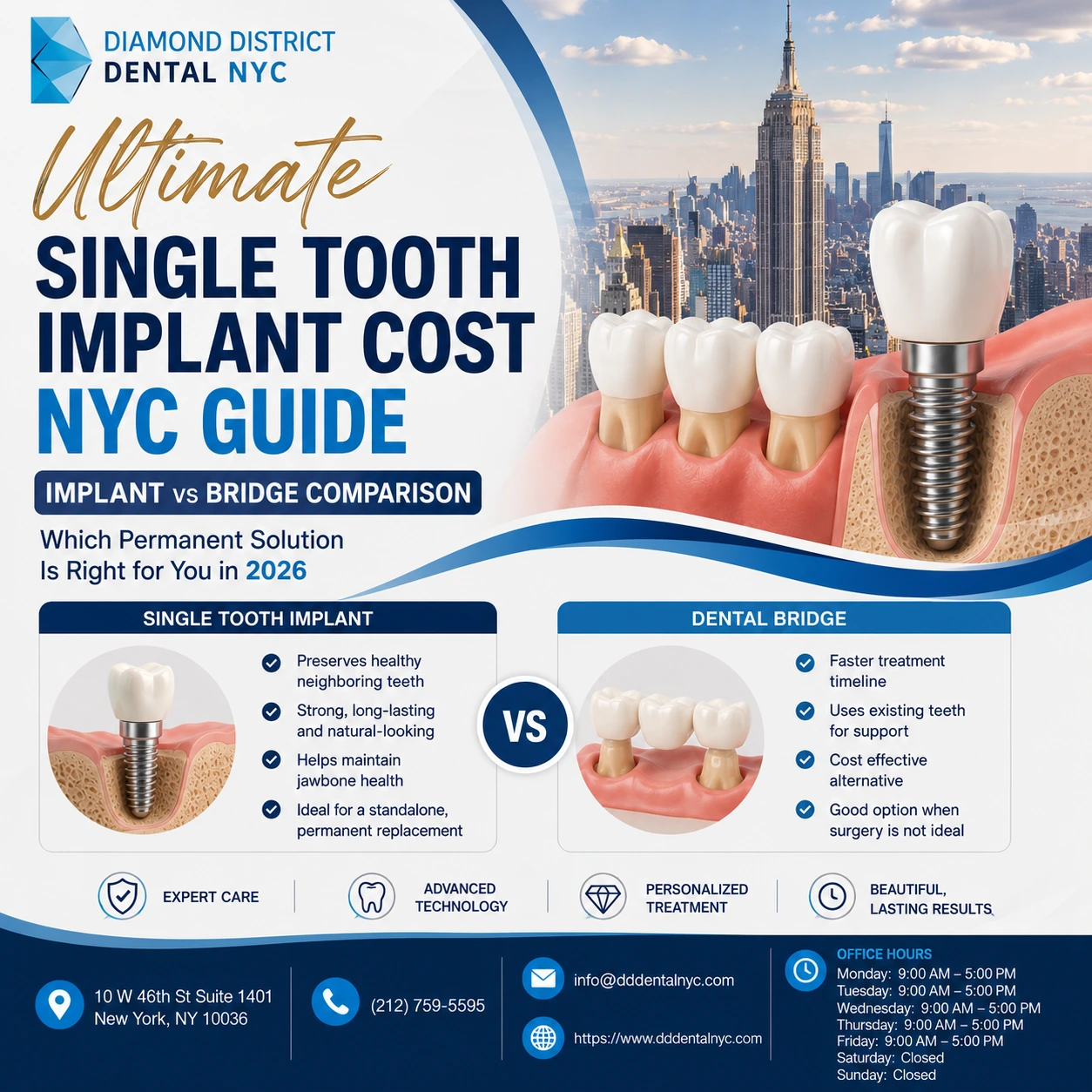
Single Tooth Implant vs Bridge: How They Compare?
Here is a clear side by side look at the most important differences.
Factor | Single Tooth Implant | Dental Bridge |
|---|---|---|
How it works | Replaces tooth root and crown | Uses neighboring teeth for support |
Effect on nearby teeth | Does not require altering adjacent teeth | Requires shaping adjacent teeth for crowns |
Bone support | Helps stimulate the jawbone | Does not replace the root or stimulate bone the same way |
Timeline | Longer, often several months | Usually faster |
Maintenance | Clean like a natural tooth with special attention around the implant | Needs careful cleaning under and around the bridge |
Longevity | Often lasts many years with good care | Can also last many years, but may need replacement sooner |
Best for | Patients wanting a standalone, root level replacement | Patients who want a faster solution or need crowns on nearby teeth |
This comparison does not mean one treatment is universally better. It simply shows that implants and bridges solve the same problem in different ways.
How Dentists Decide Which Option Fits Best?
The best choice usually starts with a clinical exam and imaging. A dentist will look at the missing tooth site, the health of nearby teeth, gum condition, bite alignment, and bone volume. In some cases, a 3D scan may be recommended to evaluate whether implant placement is feasible.
A common misconception is that the more permanent sounding option is automatically the best one. In reality, the best treatment is the one that matches your anatomy, oral health, and goals.
For example:
- If the neighboring teeth are healthy and untouched, preserving them may favor an implant
- If the adjacent teeth already have large fillings or need crowns, a bridge may be reasonable
- If bone has reduced significantly, additional procedures may be needed before implant placement
- If a patient needs a faster result, a bridge may be more practical
Patients in NYC often ask whether one option is more “modern” than the other. The answer is that both are established restorative treatments. The more important question is which one supports your long term oral health.
Single Tooth Implant Cost NYC: What Influences Price?
The phrase single tooth implant cost NYC can mean very different things depending on what is included. One practice may quote only the implant surgery, while another may include imaging, abutment, crown, and follow up visits.
Several factors can affect cost:
- Number of appointments required
- Need for extractions before placement
- Bone grafting or gum treatment
- Type of final crown material
- Use of sedation or advanced imaging
- Complexity of the case
- Whether the implant and restoration are completed by the same team
Dental bridges also vary in price depending on the number of units involved and the materials used. For some patients, a bridge may appear less expensive upfront. But because an implant preserves neighboring teeth and often lasts longer, the long term value may be different.
A practical way to compare cost is to ask each office for a written treatment estimate that explains exactly what is included. That is especially helpful for patients comparing treatment in New York City, where fees can vary widely.
Benefits and Limitations of Each Option
Here is a clear side by side look at the most important differences.
| Advantages of a single tooth implant | Limitations of a single tooth implant |
|---|---|
| Does not rely on adjacent teeth for support | Takes longer to complete |
| Helps preserve jawbone in the missing tooth area | May require bone grafting or other preparatory treatment |
| Looks and feels very natural for many patients | Not every patient is a candidate |
| Can be easier to keep clean than a bridge in some cases | Upfront cost may be higher |
| Often provides strong long term function |
| Advantages of a dental bridge | Limitations of a dental bridge |
|---|---|
| Typically completed faster | Requires altering healthy adjacent teeth |
| Does not require surgery in every case | Does not replace the root of the missing tooth |
| Can be a good solution when nearby teeth already need crowns | May need replacement over time |
| Restores appearance and chewing function predictably | Can be harder to clean under the bridge |
What Recovery Looks Like?
Recovery depends on which treatment you choose.
With an implant, mild swelling or soreness is common after surgery. Most patients can return to routine activities fairly quickly, but the bone healing phase takes longer. Good home care and follow up visits are essential during this period.
With a bridge, recovery is usually shorter because there is no implant surgery. Patients may need time to adjust to the feel of the new restoration, especially if the supporting teeth were prepared for crowns.
In both cases, oral hygiene matters. Brushing, flossing, and regular dental visits help protect the surrounding teeth and gums.
Which Option Lasts Longer?
Longevity depends on many factors, including oral hygiene, bite forces, smoking history, gum health, and regular dental care. In general, a well maintained implant can last for many years, and a bridge can also offer long term service. However, bridges may be more likely to need replacement if the supporting teeth develop decay or wear over time.
That is why a dentist will often consider not just the missing tooth, but the health of the entire area around it.
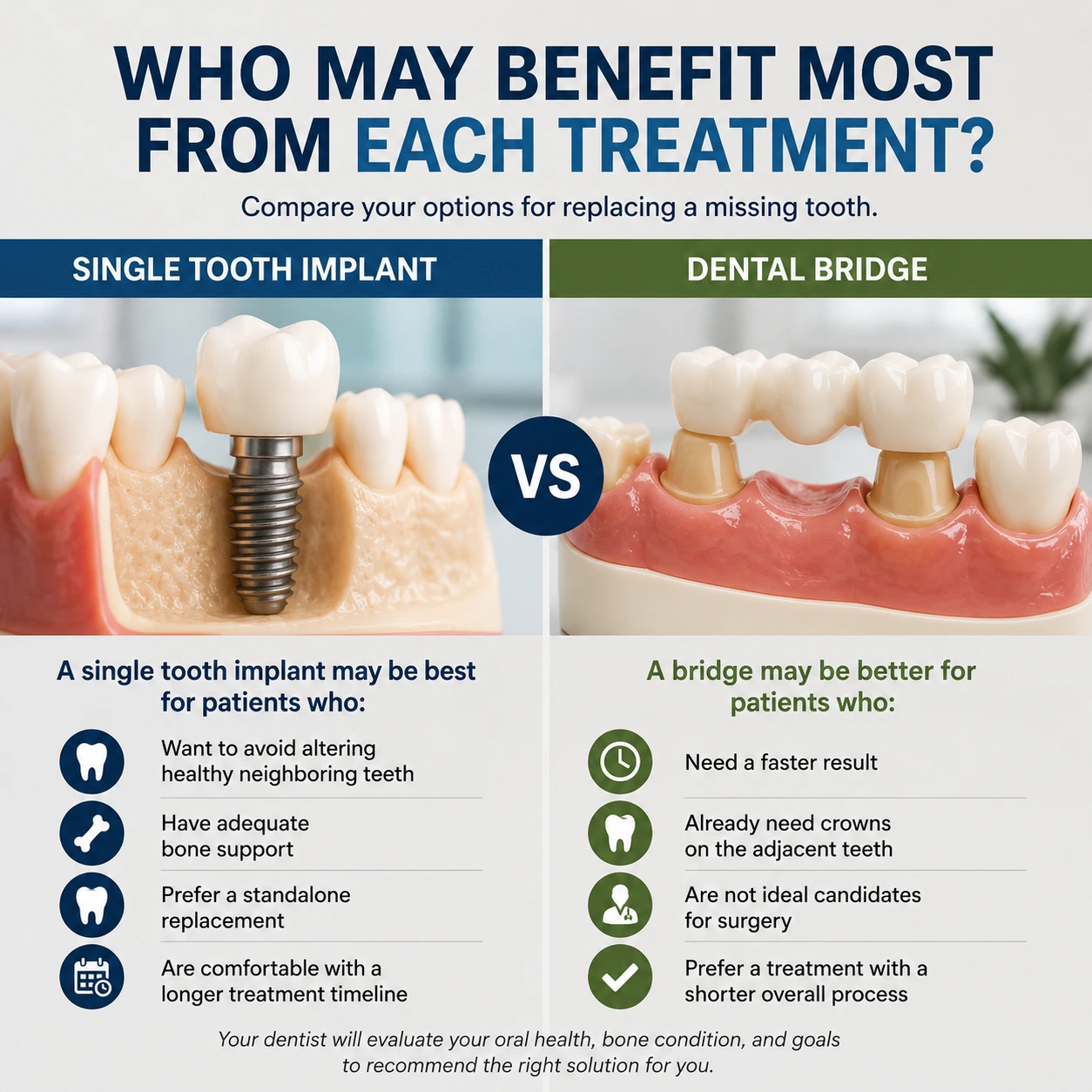
Who May Benefit Most From Each Treatment?
A single tooth implant may be best for patients who:
- Want to avoid altering healthy neighboring teeth
- Have adequate bone support
- Prefer a standalone replacement
- Are comfortable with a longer treatment timeline
A bridge may be better for patients who:
- Need a faster result
- Already need crowns on the adjacent teeth
- Are not ideal candidates for surgery
- Prefer a treatment with a shorter overall process
For some patients, the answer is not obvious until after an exam. That is why a professional evaluation matters more than an online comparison chart alone.
Questions to Ask at Your Consultation
Question | Why It Matters |
|---|---|
Am I a candidate for an implant? | Determines whether surgery and healing are realistic options |
Do I need a bone graft? | Affects timeline and cost |
Are the teeth next to the gap healthy enough for a bridge? | Helps avoid unnecessary damage to good teeth |
What is included in the quote? | Clarifies the real single tooth implant cost NYC or bridge cost |
How long will treatment take? | Helps with planning work, travel, and daily routine |
How do I maintain the restoration? | Supports long term success |
Not always. Implants preserve neighboring teeth and replace the tooth root, but bridges can be a smart option in the right clinical situation.
Treatment may take several months from placement to final crown, depending on healing and whether additional procedures are needed.
Often yes upfront, but total value depends on what is included and how long each restoration lasts.
Sometimes, yes. Bone grafting or other preparatory treatment may make implant placement possible, but you need an evaluation.
A bridge requires the adjacent teeth to be reshaped for crowns, which is why many dentists prefer to preserve healthy teeth when an implant is a good option.
Brushing, flossing, and using recommended cleaning tools are important. Your dentist may suggest special floss or interdental cleaners.
They are designed as long term restorations, but they still require maintenance and regular dental visits.
Ask for a detailed exam and written estimate. The best choice depends on your mouth, not just the price alone.
Conclusion
If you are deciding between a single tooth implant vs bridge, the best place to start is with a full dental evaluation. Both treatments can restore your smile, but they serve different needs. A bridge may be faster and appropriate in certain cases, while an implant may offer more independent support and long term preservation of nearby teeth. For patients researching single tooth implant costs in NYC, it is especially important to compare not just the price, but also what the treatment includes and how it fits your oral health goals.
If you have a missing tooth and want clear guidance on whether an implant or bridge is right for you, schedule a consultation with Diamond District Dental NYC. Our team can evaluate your teeth, review your options, and help you make a confident, informed decision about your care.