
MISSING & UNSTABLE TEETH · MIDTOWN MANHATTAN
Loose Dentures in NYC? Why Do They Slip, Rock or Lift?
A denture can become unstable because your mouth changed, the denture changed or one of its supporting components changed. More adhesive is not always the answer. The useful question is whether you need a small adjustment, a reline, repair, replacement, or maintenance of an implant attachment.
Needs more adhesive?
A changing fit should be evaluated rather than masked with larger amounts.
No longer snaps in?
Implant-overdenture attachments and the prosthesis both need maintenance over time.
Book Appointment
Get Your Consultation
Same-day replies. No obligation. A real dentist reviews every request.
Loose does not automatically mean “replace it.” A denture may need only a pressure adjustment or reline, while another may be worn, fractured, poorly balanced or affected by changes in supporting teeth or implant attachments.
20-SECOND EXPLANATION
What Does a Loose Denture Actually Mean?
Removable dentures rely on a combination of tissue adaptation, ridge shape, saliva, border seal, muscle control, bite balance and depending on the design clasps or implant attachments.
01
Full dentures rely on the ridge, borders and muscle control
Upper and lower dentures have different anatomy, so they do not behave exactly the same.
02
Partial dentures also rely on remaining teeth
Clasps, rests, supporting teeth and the tissue beneath the partial can all affect stability.
03
Implant overdentures have components that wear
A loose attachment or prosthesis is different from true mobility of the implant fixture itself.
WHAT ARE YOU NOTICING?
Common Signs Your Denture Fit Has Changed
The same symptom can have more than one cause, so movement alone does not tell you whether the fix is a reline, repair or new prosthesis.
Lower denture lifts
The lower plate moves during speech, swallowing or chewing.
Upper denture loses retention
A denture that previously stayed secure begins dropping during wider mouth movements.
Denture rocks or clicks
Uneven fit, tooth wear, bite imbalance or structural damage may be contributing.
Food gets underneath
Gaps at the tissue surface or borders can let food collect under the base.
Partial clasp feels loose
The clasp, supporting tooth, ridge or denture base may have changed.
Implant overdenture no longer snaps firmly
Attachment inserts or prosthetic components may need professional maintenance.
CONDITION-SPECIFIC INFOGRAPHIC
Why Did My Denture Become Loose?
Five common pathways help explain why a denture can start slipping even when it once felt secure.
Ridge / gum shape changed
The tissue-contacting surface no longer matches the mouth as closely as it once did.
Immediate-denture healing
Post-extraction swelling resolves and the sockets/ridge remodel during healing.
Wear / bite / fracture
The teeth, acrylic base or bite relationship may have changed.
Partial-denture support changed
A clasp, supporting tooth or saddle area may no longer provide the same retention.
Implant attachment issue
Retention inserts or other prosthetic components can wear and need maintenance.
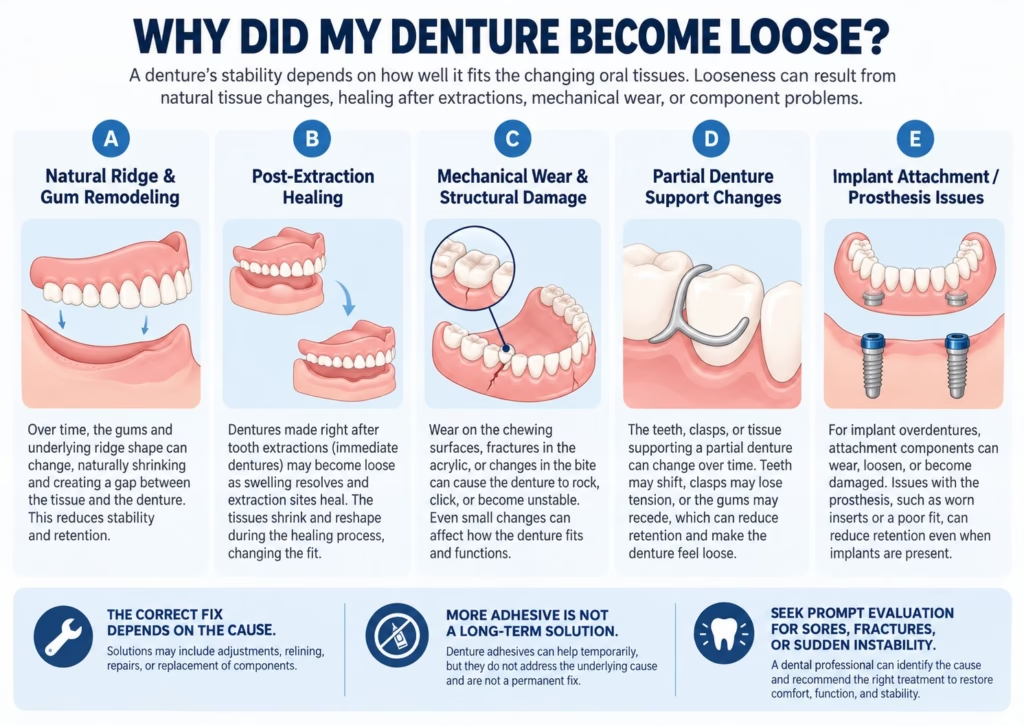
The Correct Fix Depends on What Changed
Relining corrects one kind of fit problem. It cannot repair every worn bite, broken base, loose clasp or implant component.
Not every loose denture needs replacement
Some problems are correctable with adjustment, repair or relining.
Not every loose denture needs implants
Conventional dentures remain appropriate for many patients.
Attachment looseness ≠ implant failure
The overdenture and implant fixture must be checked separately.
WHY FIT CHANGES OVER TIME
Your Denture Is Rigid Your Mouth Is Not
After teeth are lost, the residual ridge and overlying soft tissues continue to remodel. Denture teeth and components can also wear.
Residual Ridge Remodeling
As the shape of the ridge changes, an older acrylic base may no longer contact the tissues evenly. That can create rocking, loss of retention or food trapping.
- The amount and rate of remodeling vary.
- A loose denture does not automatically mean severe bone loss.
- More advanced ridge loss may affect whether relining is enough.
Denture Wear & Bite Changes
Artificial teeth wear, acrylic can be damaged, and the bite can become less balanced. A denture may therefore rock even when tissue adaptation is only part of the problem.
- Clicking does not automatically mean replacement.
- A crack can cause sudden instability.
- A reline cannot correct every worn or poorly balanced bite.
IMMEDIATE & PARTIAL DENTURES
Some Denture Types Become Loose for Different Reasons
Immediate Dentures During Healing
An immediate denture is inserted around the time teeth are removed. As swelling decreases and the extraction sites remodel, the fit can change substantially.
- Follow-up adjustments are expected in many cases.
- A temporary liner or later reline may be considered when appropriate.
- There is no universal healing or reline schedule for every patient.
Partial Dentures & Supporting Teeth
A removable partial depends on both the ridge and the remaining natural teeth. Looseness may reflect clasp/component wear, ridge change or a change in a supporting tooth.
- Do not bend a clasp with household tools.
- A painful or newly mobile supporting tooth needs its own examination.
- A damaged clasp or base may be repairable.
ADA guidance for partial dentures
The ADA advises that partial dentures should fit into place without being forced and that poorly fitting dentures should be professionally adjusted. It also warns against DIY repair and household glues.
DENTURE-FIT EVALUATION
How Does a Dentist Evaluate Loose Dentures?
The examination should evaluate the mouth and prosthesis together- not just add adhesive or grind the acrylic until it feels better.
KEY DISTINCTION
If an implant-supported denture feels loose, the clinician should determine whether the removable prosthesis/attachment is moving or the implant fixture itself is mobile.
Review the denture history
When was it made, when did the looseness begin, and has adhesive use, extraction healing or comfort changed?
Inspect the gums and residual ridge
Sore areas, tissue inflammation, ridge shape and dry mouth can all affect comfort and retention.
Check base adaptation and borders
The dentist looks for gaps, overextension, distortion, cracks and areas that move during speech or function.
Evaluate the bite and components
Denture-tooth wear, partial clasps, supporting teeth and implant attachments are checked separately.
Use imaging only when it changes planning
X-rays or other imaging may be appropriate for supporting teeth, implant components or future implant treatment.
THE PRACTICAL FIX
Adjustment vs. Reline vs. Rebase vs. Repair vs. Replacement
These terms solve different problems. A reline is not a universal fix for every loose denture.
SMALL CORRECTION
Adjustment
Selective modification of pressure areas, borders or bite contacts when the overall denture remains serviceable.
TISSUE-CONTACT FIT
Reline
Resurfaces the inside of an existing denture so it adapts more closely to changed tissues when the teeth, bite and base remain suitable.
NEW BASE
Rebase
Replaces most or all of the denture base while retaining usable denture teeth in selected cases.
DAMAGED COMPONENT
Repair
Addresses a fracture, broken denture tooth, damaged clasp or other repairable component.
BROADER WEAR / MISMATCH
Replacement
A new denture may be more predictable when the existing prosthesis is heavily worn, repeatedly fractured, poorly balanced or no longer suitable to correct.
SELECTED ADDED RETENTION
Implant Supported Evaluation
Implants can increase retention for selected patients, but require surgical candidacy and ongoing component/prosthesis maintenance.
DENTURE-FIT EVALUATION
How Does a Dentist Evaluate Loose Dentures?
Loss of the snap does not automatically mean the implant itself has failed.
| What May Be Loose | What You May Notice | What Needs Checking |
|---|---|---|
| Attachment Insert | The overdenture no longer clicks or holds as firmly as before. | Retention inserts/housings may be worn and require professional maintenance. |
| Denture Base / Prosthesis | Rocking persists even though attachments engage. | Base adaptation, fracture, bite and tissue support should be evaluated. |
| Abutment / Prosthetic Component | One side feels mechanically different or makes a new clicking sensation. | Professional component inspection; do not tighten anything yourself. |
| Implant Fixture Itself | The implant post appears to move relative to the jaw. | This is not expected and needs prompt clinical evaluation. |
DENTURE CARE
What Can You Safely Do at Home?
Home care protects the prosthesis and oral tissues, but it cannot permanently correct a changed fit.
Helpful habits
- Rinse dentures before brushing and use a soft brush with a non-abrasive denture cleanser.
- Clean the gums, tongue and palate daily even if you have no natural teeth.
- Follow your dentist's instructions for when to remove the denture and how to store it when out of the mouth.
- Use denture adhesive only according to product directions or dental guidance.
- Keep regular dental exams so the fit, tissues and any remaining teeth or implants can be monitored.
Do not DIY the fit
- Do not bend partial-denture clasps yourself.
- Do not grind or file acrylic at home.
- Do not use household glue or superglue for repairs.
- Do not rely on increasing adhesive to compensate for severe rocking.
- Do not attempt to tighten implant or attachment components yourself.
WHEN LOOSE DENTURES NEED FASTER ATTENTION
When Should You Stop “Making It Work” and Get It Checked?
Most denture looseness is not an emergency, but sores, fractures, supporting-tooth pain or implant mobility should not simply be covered with adhesive.
A sore keeps returning or does not heal
Persistent or recurrent oral lesions deserve examination rather than repeated self-adjustment.
The denture suddenly cracks or develops a sharp edge
Stop forcing a damaged prosthesis to function and arrange professional repair.
A partial is hurting or loosening a supporting tooth
The natural tooth and the prosthesis both need evaluation.
An implant overdenture suddenly loses retention
Attachment or prosthetic components may need maintenance.
The implant fixture itself seems mobile
True implant mobility is not expected and requires prompt professional assessment.
MEDICAL EMERGENCY
If swelling is rapidly increasing or affecting breathing or swallowing, there is uncontrolled oral bleeding, major trauma or another life-threatening emergency, call 911 or go to the nearest emergency department.
MEET YOUR DENTIST
Experienced Care Starts with the Right Evaluation
Dr. Oleg Klempner brings more than 30 years of experience caring for patients throughout New York City. At Diamond District Dental NYC, every recommendation starts with a careful evaluation of your dental health, symptoms, and individual needs so you can understand what is happening and what your next step may be.
30+ Years
Serving NYC
NYU
College of Dentistry
Midtown
10 W 46th Street
Health First
Teeth, gums & bite
Common Questions
Questions Patients Ask About Loose Dentures
The mouth may have changed from ridge remodeling, or the denture itself may have worn, fractured or lost bite balance. Partial-denture clasps and implant attachments can also change.
The lower arch has less broad supporting surface and more interaction with the tongue and floor of the mouth. Border shape, ridge anatomy, bite and fit all influence movement.
Changes in tissue adaptation, the border seal, ridge shape, saliva or the denture itself can reduce retention. A previously secure upper denture that starts dropping should be checked.
After extractions, swelling resolves and the sockets and ridge remodel. The immediate denture stays rigid while the mouth changes, so adjustment or relining may be needed.
Often, when the main problem is loss of tissue adaptation and the denture teeth, bite and base are otherwise serviceable. Not every loose denture is a good reline candidate.
Often, when the main problem is loss of tissue adaptation and the denture teeth, bite and base are otherwise serviceable. Not every loose denture is a good reline candidate.
Not necessarily. FDA guidance says larger amounts do not necessarily solve an ill-fitting denture. If you need progressively more adhesive, have the fit checked.
Rocking and concentrated pressure can contribute to traumatic irritation, but recurrent or persistent sores should be examined because not every oral lesion is simply friction.
Loss of close adaptation or border seal can allow food to enter beneath the base. Repeated major food trapping is a reason to evaluate the fit.
There is no single expiration date. Replacement may be more predictable when teeth are heavily worn, the base repeatedly fractures, the bite is unsuitable or a reline cannot correct the fit.
Yes. Retention inserts and prosthetic components can wear, and the denture base itself can develop fit issues. These problems are different from actual mobility of the implant fixture.
If the implant fixture itself appears to move relative to the jaw, that is not expected and should be evaluated promptly. Do not try to tighten implant components yourself.
RELATED DENTAL CONCERNS
Where Loose Dentures Can Connect Next
Denture instability can overlap with ridge loss, missing teeth, supporting-tooth mobility, periodontal disease and implant-component problems.
Missing Teeth
For the broader replacement decision behind removable dentures.
Severe Bone Loss
For significant residual-ridge loss affecting denture or implant planning.
Loose Adult Teeth
For a partial denture supported by teeth that have become mobile.
Gum Disease
For periodontal support changes around the remaining natural teeth.
Failing Dental Implant
For future routing when true implant mobility, pain or peri-implant disease is suspected.
Dry Mouth
For future routing when reduced saliva is a major comfort or retention problem.
FIX THE CAUSE OF THE MOVEMENT
Not Sure Whether You Need an Adjustment, Reline, Repair or a New Denture?
Bring the denture with you. The useful answer comes from checking the mouth, the prosthesis, the bite and any supporting teeth or implants together.