
MISSING & UNSTABLE TEETH · MIDTOWN MANHATTAN
Severe Jawbone Loss in NYC? What Does “Not Enough Bone” Actually Mean?
“Bone loss” describes a structural change not one single disease. It may involve bone around natural teeth, remodeling after tooth loss, a localized deficient implant site, or bone loss around an existing implant. The cause and location determine whether the next step is periodontal care, monitoring, bone augmentation, prosthetic treatment or advanced implant planning.
“Not enough bone”
Usually describes a specific implant site not failure of the whole jaw.
Severe upper-jaw loss
Selected patients may have grafting or advanced implant pathways after detailed evaluation.
Book Appointment
Get Your Consultation
Same-day replies. No obligation. A real dentist reviews every request.
Being told you have bone loss does not automatically mean “no implants,” “all teeth must come out,” or “you need zygomatic implants.” Bone quantity, location, periodontal health, remaining teeth, medical history and the final restorative plan all matter.
20-SECOND EXPLANATION
What Does Dental or Jawbone Loss Mean?
The alveolar portion of the upper and lower jaw supports natural tooth roots and later forms the residual ridge after teeth are lost. Dental implants also depend on surrounding bone for stability. “Bone loss” can therefore describe several different clinical situations.
01
Bone loss around natural teeth
Periodontitis can destroy attachment and supporting alveolar bone, leading to mobility or shifting.
02
Ridge remodeling after tooth loss
The socket heals after extraction while the surrounding ridge naturally changes in width and height.
03
Bone loss around an implant
Peri-implant inflammation or another implant complication is evaluated separately from periodontal disease around natural teeth.
WHAT PATIENTS MAY NOTICE
Dental Bone Loss Often Shows Up Indirectly
You usually cannot judge the true extent of bone loss in a mirror. Clinical examination and dental imaging are needed.
Teeth become loose or start spreading
Progressive periodontal support loss can allow teeth to move or change position.
Teeth look longer
Recession and attachment loss can expose more root surface.
An old missing-tooth site looks narrow
The residual ridge may have remodeled since the tooth was lost.
A denture becomes less stable
Changes in the supporting ridge may contribute to rocking or loss of retention.
You were told an implant site lacks bone
The site may be too narrow, too short, or close to the sinus or nerve for the planned implant position.
An implant develops bleeding or swelling
Peri-implant inflammation or another implant complication requires its own evaluation.
CONDITION-SPECIFIC INFOGRAPHIC
Why Is Dental Bone Being Lost?
The location and cause matter because periodontal support loss, post-extraction remodeling and peri-implant disease are not interchangeable.
Periodontitis
Inflammatory periodontal disease can destroy bone supporting natural tooth roots.
After tooth loss
The extraction socket heals while the residual ridge naturally remodels.
Long-standing tooth loss
Ridge changes over time can affect denture support or available implant dimensions.
Localized defect
Past infection, trauma or site-specific anatomy can leave one area deficient.
Around an implant
Peri-implant inflammation or another implant complication can reduce supporting bone.
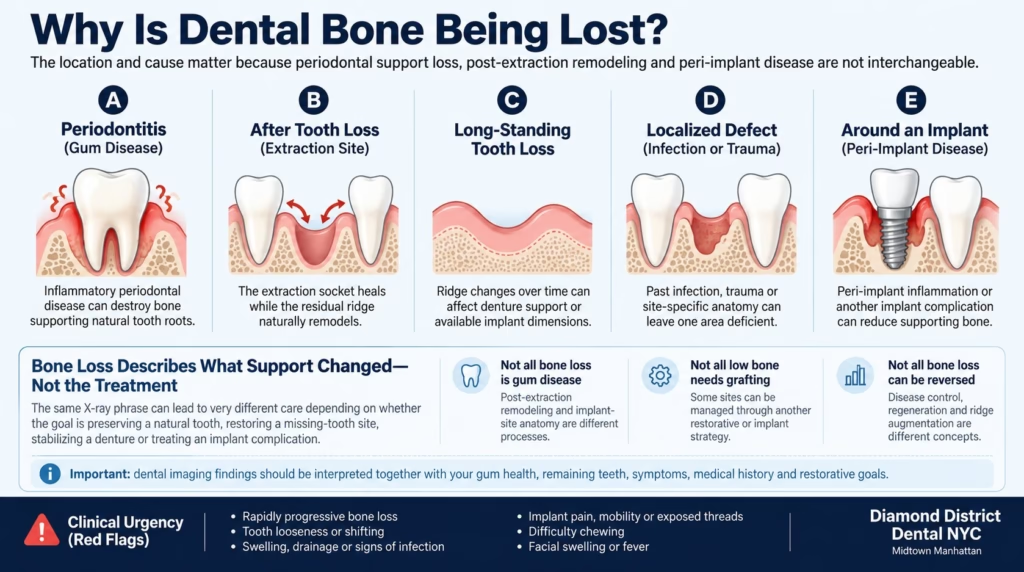
Bone Loss Describes What Support Changed Not the Treatment
The same X-ray phrase can lead to very different care depending on whether the goal is preserving a natural tooth, restoring a missing-tooth site, stabilizing a denture or treating an implant complication.
Not all bone loss is gum disease
Post-extraction remodeling and implant-site anatomy are different processes.
Not all low bone needs grafting
Some sites can be managed through another restorative or implant strategy.
Not all bone loss can be reversed
Disease control, regeneration and ridge augmentation are different concepts.
Periodontal bone loss is a structural support problem
NIDCR explains that advanced periodontal disease can destroy bone supporting the teeth and may lead to tooth looseness or shifting.
PERIODONTAL VS. POST-EXTRACTION BONE CHANGE
Two Common Types of Bone Loss That Should Not Be Confused
NATURAL TEETH STILL PRESENT
Periodontal Bone Loss
Periodontitis damages the tissues and bone that support tooth roots.
- May be accompanied by bleeding, recession, pockets, mobility or tooth migration.
- Gingivitis alone does not include the attachment/bone destruction of periodontitis.
- The priority is controlling disease and deciding which teeth can be predictably maintained.
TOOTH ALREADY MISSING
Residual-Ridge Remodeling
After extraction, the socket heals while the shape of the surrounding alveolar ridge changes.
- This is a normal biological response after loss of the tooth/periodontal complex.
- The amount varies considerably by site and patient.
- The focus shifts to replacement planning and whether site development is useful.
HIGH-INTENT PATIENT QUESTION
“I Was Told I Don’t Have Enough Bone for Implants.” What Does That Actually Mean?
It usually means the planned implant site does not currently have the right amount or shape of bone for that specific implant position not that the entire jaw is unsuitable.
Implant Planning Is Three-Dimensional
The clinician considers the width and height of the ridge, the final tooth or prosthesis position, surrounding soft tissue and nearby anatomy.
- Upper-back sites may have limited height beneath the maxillary sinus.
- Lower-back sites must respect the course of the inferior alveolar nerve.
- One site can be deficient while another part of the jaw has adequate bone.
Bone Volume and Bone Quality Are Different
Volume describes how much bone is physically available. Quality describes structural characteristics that influence implant stability and healing.
- No single density number determines candidacy by itself.
- Standard X-rays answer some questions; selected implant/graft cases benefit from 3D imaging.
- The final restorative plan determines where bone is actually needed.
BONE-LOSS EVALUATION
How Does a Dentist Evaluate Severe Bone Loss?
The goal is to understand the cause, location and remaining support before deciding whether to preserve, augment or bypass a deficient area.
Do not stop osteoporosis medication on your own:
if you take bisphosphonates, denosumab or another antiresorptive medication, tell both your dental team and prescribing clinician so treatment can be planned appropriately.
Clarify the history
When were teeth lost, was periodontitis involved, how long has a denture been worn, and are implants already present?
Check periodontal support
Probing, bleeding, recession, mobility and tooth position help distinguish active periodontal disease from a toothless ridge problem.
Examine the residual ridge
The clinician evaluates ridge contour, width, soft tissue and the prosthetic space available for replacement.
Review medical and medication factors
Smoking, diabetes, osteoporosis history and antiresorptive medications can affect surgical planning and healing considerations.
Use imaging appropriate to the decision
Dental radiographs show bone levels; selected implant or graft cases may require CBCT to evaluate ridge dimensions, sinus position and nerve anatomy.
CAN JAWBONE GROW BACK?
Disease Control, Regeneration and Bone Grafting Are Three Different Things
The phrase “grow bone back” can be misleading because different procedures pursue different biological goals.
STOP PROGRESSION
Periodontal Disease Control
Scaling/root planing, periodontal maintenance and selected surgical or laser approaches aim to control inflammation and preserve remaining support. They do not automatically recreate all lost bone height.
SELECTED DEFECTS
Periodontal Regeneration
Some localized periodontal defects may be candidates for regenerative techniques. Anatomy, defect shape and disease control influence whether regeneration is realistic.
BUILD IMPLANT-SITE VOLUME
Bone Grafting / Ridge Augmentation
Bone or bone-substitute material can be used as part of rebuilding a deficient ridge for selected implant or restorative plans.
UPPER POSTERIOR JAW
Sinus Augmentation
When upper-back implant sites have insufficient vertical bone beneath the maxillary sinus, selected patients may be considered for sinus augmentation.
Professional guidance on rebuilding deficient implant sites
The American Academy of Periodontology describes ridge modification as filling deficient ridge areas with bone or bone substitute to improve implant-site anatomy. AAOMS describes grafts as replacement or scaffold materials used to create adequate bone quantity and quality where needed.
DENTURE-FIT EVALUATION
How Does a Dentist Evaluate Loose Dentures?
The examination should evaluate the mouth and prosthesis together- not just add adhesive or grind the acrylic until it feels better.
| What May Be Loose | What You May Notice | What Needs Checking |
|---|---|---|
| Attachment Insert | The overdenture no longer clicks or holds as firmly as before. | Retention inserts/housings may be worn and require professional maintenance. |
| Denture Base / Prosthesis | Rocking persists even though attachments engage. | Base adaptation, fracture, bite and tissue support should be evaluated. |
| Abutment / Prosthetic Component | One side feels mechanically different or makes a new clicking sensation. | Professional component inspection; do not tighten anything yourself. |
| Implant Fixture Itself | The implant post appears to move relative to the jaw. | This is not expected and needs prompt clinical evaluation. |
PROTECT THE BONE YOU STILL HAVE
What Can You Safely Do at Home?
Home care is essential for disease control and maintenance, but it cannot reconstruct a deficient ridge.
Helpful habits
- Brush remaining natural teeth twice daily with fluoride toothpaste.
- Clean between teeth and around implant restorations using the method your dental team recommends.
- Maintain periodontal and implant follow-up appropriate to your risk level.
- Keep removable dentures and underlying tissues clean.
- Discuss tobacco use, diabetes control and healing risks with your dental and medical teams where relevant.
What home care cannot do
- It cannot regrow extensive lost alveolar bone.
- It cannot create the width or height needed for a deficient implant site.
- It cannot stabilize a truly mobile dental implant.
- It cannot change sinus or nerve anatomy.
- Vitamins, calcium or “bone-building” supplements do not reconstruct a deficient dental ridge.
WHEN BONE-LOSS FINDINGS NEED FASTER ATTENTION
When Should You Seek Prompt Dental Care?
Most ridge remodeling is gradual. New mobility, swelling, drainage, exposed bone or an implant that moves are different.
Newly loose or rapidly shifting adult teeth
Progressive support loss, trauma or infection needs professional evaluation.
Swelling, pus, drainage or significant pain
These findings can indicate active infection rather than uncomplicated chronic ridge loss.
Exposed bone or a site that is not healing normally
Especially important after extraction or in patients taking medications that affect bone remodeling.
Bleeding or swelling around an implant
Peri-implant inflammation should be assessed before more support is lost.
The implant fixture itself feels mobile
True implant mobility is not expected and requires prompt professional assessment.
Rapid facial/oral swelling or difficulty breathing/swallowing?
Seek emergency medical care immediately rather than waiting for a dental appointment.
MEET YOUR DENTIST
Experienced Care Starts with the Right Evaluation
Dr. Oleg Klempner brings more than 30 years of experience caring for patients throughout New York City. At Diamond District Dental NYC, every recommendation starts with a careful evaluation of your dental health, symptoms, and individual needs so you can understand what is happening and what your next step may be.
30+ Years
Serving NYC
NYU
College of Dentistry
Midtown
10 W 46th Street
Health First
Teeth, gums & bite
Common Questions
Questions Patients Ask About Severe Dental Bone Loss
Dental bone loss can result from periodontitis around natural teeth, normal ridge remodeling after tooth loss, localized infection or trauma defects, or bone loss around an implant. The cause depends on the site.
Yes. Periodontitis can destroy the attachment and alveolar bone that support natural teeth. Gingivitis alone does not include that deeper support loss.
Not in one simple way. Controlling periodontal disease helps stop progression; selected periodontal defects may be regenerative candidates; and grafting or augmentation can rebuild selected deficient toothless areas.
Possibly. Some patients can use augmentation, sinus procedures, altered implant planning or advanced upper-jaw options. Others may be better served by a different prosthetic strategy. Candidacy requires examination and imaging.
Ask which site is deficient and whether the issue is ridge width, height, sinus or nerve anatomy, bone quality or prosthetic positioning. “Not enough bone” is often site-specific.
A graft uses bone or a bone-substitute material to fill or augment a deficient area and can serve as a scaffold for new bone formation in selected cases.
Ridge augmentation rebuilds the contour or volume of a deficient toothless ridge, often as part of preparing a site for implant-supported treatment.
No. Some sites already have adequate anatomy, some can be augmented, and selected cases may use another implant or restorative approach.
Zygomatic implants are longer implants that use the zygomatic cheekbone region for support in selected severe upper-jaw bone-loss cases. They are not used for lower-jaw bone loss.
Residual-ridge remodeling can reduce the support and adaptation of a conventional denture, contributing to rocking, food trapping or increased adhesive use.
No. Osteoporosis is a systemic skeletal condition, while dental or alveolar bone loss is usually a local oral finding. Osteoporosis and its medications still matter when surgical treatment is being planned.
RELATED DENTAL CONCERNS
Where Loose Adult Teeth Can Connect Next
Mobility overlaps with gum support, recession, trauma, cracks, infection and missing-tooth planning.
Gum Disease
For active periodontitis and periodontal attachment or bone loss around natural teeth.
Loose Adult Teeth
For mobile natural teeth with periodontal, traumatic or structural causes.
Gum Recession
For exposed roots and gumline changes that may coexist with periodontal support loss.
Loose Dentures
For changing ridge support beneath a removable prosthesis.
Missing Teeth
For replacement planning after a tooth has already been lost or removed.
Failing Dental Implant
For future routing when implant-specific bone loss, bleeding or mobility is the primary concern.
A BONE-LOSS FINDING IS THE START OF PLANNING
Told You Have Severe Bone Loss or “Not Enough Bone” for Implants?
The next step is to identify where the deficiency is, why it developed, which anatomical structures are nearby and what type of final restoration the area needs to support.