
MISSING & UNSTABLE TEETH · MIDTOWN MANHATTAN
Missing Teeth in NYC? What Happens After Tooth Loss?
A missing tooth is the condition the replacement is the treatment decision. A gap can affect appearance, chewing or speech, and in some patients nearby teeth and the supporting jaw ridge gradually change. Whether that space should be monitored, restored with a bridge, replaced with an implant or managed another way depends on the whole mouth.
One tooth is missing
Implant, bridge, removable or space-management options may all be considered.
Several teeth are missing
Function, bone support and the remaining teeth become more important to planning.
Book Appointment
Get Your Consultation
Same-day replies. No obligation. A real dentist reviews every request.
Not every missing tooth automatically needs an implant or even replacement. A dentist considers chewing, appearance, speech, space stability, periodontal health, bone, the opposing teeth and your own goals before recommending a plan.
20-SECOND EXPLANATION
What Does “Missing Teeth” Mean Clinically?
A permanent tooth may be absent because it was lost, extracted, knocked out or never developed. One front-tooth gap and complete tooth loss are part of the same broad condition, but their functional and treatment needs are very different.
01
One missing tooth
A single anterior or posterior gap may affect appearance, chewing, space or the bite depending on location.
02
Multiple missing teeth
Several gaps can reduce chewing contacts and may require a bridge, partial denture, implants or broader reconstruction planning.
03
Complete tooth loss
When all teeth in an arch are missing, treatment can range from conventional dentures to implant-supported removable or fixed prostheses in selected patients.
WHAT ARE YOU NOTICING?
Common Missing-Tooth Situations
The location, age of the gap, surrounding teeth and presence of a current denture all change the next step.
One front tooth is missing
The concern may be primarily aesthetic and phonetic, but ridge contour and neighboring teeth also matter.
One molar is missing
The gap may be invisible in the smile yet still affect chewing contacts and space stability.
An old gap has become narrower
Nearby teeth may have tilted or drifted, changing the space available for replacement.
The opposing tooth looks longer
An unopposed tooth can move farther into the missing-tooth space in some patients.
Several teeth are missing
Chewing, denture stability, periodontal support and reconstruction strategy become more important.
The ridge looks sunken
The bone and soft-tissue contour naturally remodel after tooth loss and may affect future replacement planning.
CONDITION-SPECIFIC INFOGRAPHIC
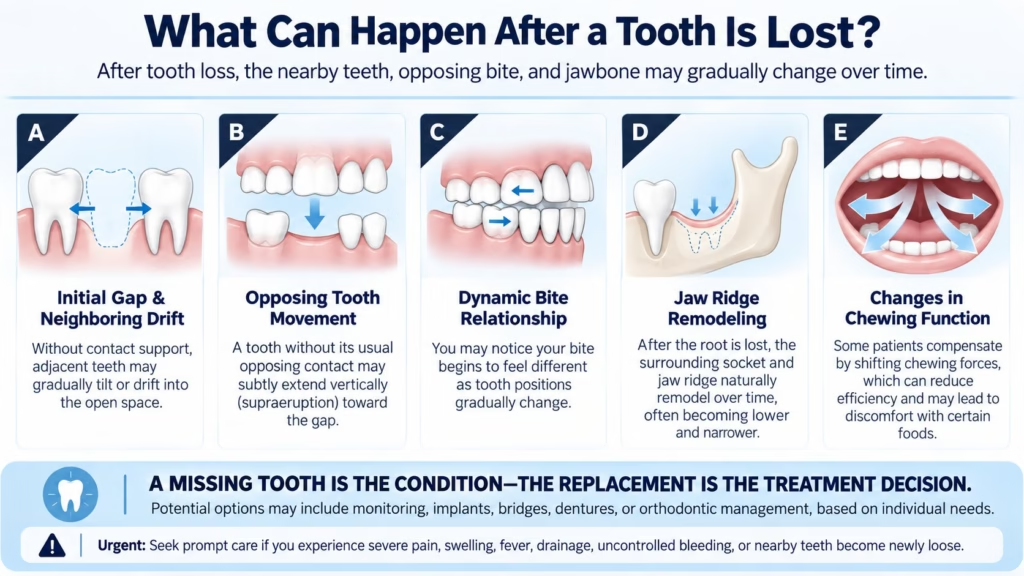
What Can Happen After a Tooth Is Lost?
These are possible changes not a guaranteed sequence. Some gaps remain relatively stable for years while others change more noticeably.
The gap remains
The socket heals and the missing-tooth space remains between the neighboring teeth.
Neighbors may drift or tilt
Adjacent teeth can slowly move into the space in some patients.
The opposing tooth may move
An unopposed tooth can supraerupt toward the gap.
The jaw ridge remodels
The extraction socket and alveolar ridge gradually change width and height.
Chewing may change
Some patients compensate by chewing differently, especially with multiple missing back teeth.
A Gap Can Affect More Than the Empty Space
The ADA notes that missing teeth can affect eating or speaking, remaining teeth may shift, and bone loss can occur around the missing-tooth area.
Movement is not guaranteed
Location, bite, time and periodontal support influence whether teeth drift or supraerupt.
Bone does not “disappear”
The extraction area remodels gradually; the amount varies by site and patient.
Replacement is individualized
Monitoring can be reasonable in selected stable situations.
WHY TEETH ARE LOST
What Can Lead to Adult Tooth Loss?
A missing tooth is the endpoint. The original dental problem should still be understood- especially if the same risk could affect the remaining teeth.
Replacement planning starts by understanding why the tooth was lost.
Check the remaining teeth
Decay, cracks and periodontal disease can affect more than one site.
Stabilize active disease
Replacement lasts longer when the rest of the mouth is healthy and maintainable.
Then plan the gap
The replacement should fit the bone, bite, neighboring teeth and patient goals.
Severe tooth decay
Extensive caries can leave too little predictable tooth structure for restoration.
Periodontitis
Loss of attachment and supporting bone can make an adult tooth mobile and, in advanced cases, unsalvageable.
Trauma
Falls, accidents or sports injuries can fracture, displace or completely avulse a permanent tooth.
Non-restorable fracture
Selected root fractures or severe structural damage can make predictable restoration impossible.
Failed prior treatment
A previously treated tooth may occasionally need extraction if recurrent disease and structural compromise cannot be predictably managed.
Congenital absence
Some permanent teeth never form, leaving a developmental space rather than an acquired tooth-loss site.
FRONT TOOTH VS. BACK TOOTH
Why the Location of the Missing Tooth Matters
A missing tooth is the endpoint. The original dental problem should still be understood- especially if the same risk could affect the remaining teeth.
Missing Front Tooth
Anterior tooth loss is usually noticed immediately because it changes the visible smile and can affect certain speech sounds.
- Aesthetic ridge contour is especially important.
- Temporary replacement may be useful during healing.
- Implant, bridge, removable or orthodontic strategies may be considered depending on the site.
Missing Molar / Back Tooth
A posterior gap may be hidden but can still affect chewing contacts, space stability and the opposing tooth.
- Some spaces remain relatively stable.
- Old gaps may have less room for a replacement than a recent gap.
- Orthodontic space management may sometimes be needed before restoration.
BONE & SPACE CHANGES
What Happens to the Jaw Ridge and Nearby Teeth Over Time?
After extraction, the socket heals and the alveolar ridge naturally remodels. Tooth movement may also occur, but neither process follows one universal timeline.
The Jaw Ridge Remodels After Tooth Loss
The bone that formed the tooth socket changes shape after the root is gone. Width and height can decrease, particularly earlier in healing, and the overlying gum contour follows the ridge.
- The amount of remodeling varies by site and anatomy.
- An implant does not automatically restore bone already lost.
- More advanced ridge loss may require grafting or another treatment strategy.
Nearby Teeth May Change Position
Teeth next to a gap can drift, rotate or tip, and an opposing tooth can move farther into the missing tooth space. The amount varies widely.
- Some spaces remain relatively stable.
- Old gaps may have less room for a replacement than a recent gap.
- Orthodontic space management may sometimes be needed before restoration.
A KEY TREATMENT QUESTION
Does Every Missing Tooth Need to Be Replaced?
No. Replacement is often useful, but it is not a universal rule.
When the Gap Affects Health, Function or Goals
- Chewing is less comfortable or one-sided.
- The missing tooth is visible or affects speech.
- Nearby or opposing teeth are moving.
- The gap is part of a broader restorative plan.
- Several teeth are missing and bite support is reduced.
When the Space Is Stable and Functional
- Selected posterior spaces with acceptable function.
- Missing or extracted wisdom teeth that do not require replacement.
- Planned orthodontic closure of the space.
- Medical or anatomical constraints that change the risk-benefit balance.
- Informed patient preference after discussing trade offs.
MISSING TOOTH EVALUATION
How Does a Dentist Evaluate a Missing Tooth?
The best replacement cannot be chosen from the gap alone. The surrounding teeth, gums, ridge and bite all matter.
IMPORTANT NOTE
If gum disease caused the tooth loss: the remaining teeth and periodontal tissues should be stabilized before definitive replacement planning.
Review how and when the tooth was lost
Decay, gum disease, trauma, extraction history and congenital absence can change the long term plan.
Check neighboring and opposing teeth
The dentist looks for drift, tilt, supraeruption, decay, existing crowns and periodontal support.
Evaluate gum and ridge health
Ridge shape, soft tissue, active periodontal disease and the width of the restorative space are assessed.
Check chewing and the bite
The location of functional contacts helps determine whether the gap is stable or changing the way the mouth works.
Use imaging when appropriate
Dental X-rays and, for selected implant planning, 3D imaging may be used to assess bone and nearby anatomical structures.
TREATMENT FOLLOWS THE WHOLE MOUTH
What Are the Main Options for Missing Teeth?
The number of missing teeth, bone, periodontal health, neighboring teeth and whether you want a removable or fixed solution all influence treatment.
SELECTED STABLE GAPS
Monitoring / No Replacement
Some spaces can be monitored when function, bite and surrounding teeth are stable and the patient is comfortable with the gap.
SINGLE-TOOTH REPLACEMENT
Dental Implant
An implant fixture placed in the jaw can support a crown for selected patients with appropriate oral health, anatomy and healing capacity.
FIXED TOOTH-SUPPORTED OPTION
Dental Bridge
A conventional bridge uses adjacent teeth to support a prosthetic tooth over the gap and may be especially reasonable when those teeth already need crowns.
REMOVABLE REPLACEMENT
Partial or Complete Denture
Partial dentures can replace several gaps while complete dentures replace an arch with no remaining natural teeth.
MULTIPLE-TOOTH SUPPORT
Implant-Supported Prosthesis
Selected patients can use implants to support a bridge, removable overdenture or full-arch prosthesis depending on the anatomy and goals.
EXTENSIVE TOOTH LOSS
Full Mouth Reconstruction
When many teeth are missing, failing or structurally compromised, treatment may need to combine several restorative approaches rather than address one gap at a time.
PROTECT THE REMAINING TEETH
What Can You Safely Do While a Gap Is Present?
Home care cannot replace the lost tooth, but it can protect the teeth and tissues that remain.
Helpful habits
- Brush remaining teeth twice daily with fluoride toothpaste.
- Keep the gap and exposed side surfaces of neighboring teeth clean.
- Clean under bridges with the interdental method recommended by your dental team.
- Remove and clean removable dentures as directed and keep the supporting tissues clean.
- Maintain regular examinations so tooth movement, periodontal health and denture fit can be monitored.
What home care cannot do
- It cannot regrow a missing permanent tooth.
- It cannot rebuild a reduced jaw ridge or create implant support.
- It cannot reposition drifting or supraerupted teeth.
- It cannot permanently correct a poorly fitting denture.
- Avoid DIY replacement teeth, non-dental adhesives or unsupervised devices in the gap.
WHEN TOOTH LOSS NEEDS FASTER ATTENTION
When Is a Missing-Tooth Situation Urgent?
Most old gaps are not emergencies. A newly knocked-out permanent tooth, uncontrolled bleeding, significant swelling or infection-related symptoms are different.
A permanent tooth was just knocked out
Dental avulsion is time-sensitive and should be evaluated immediately.
Bleeding will not stop after extraction or trauma
Persistent heavy bleeding needs prompt dental or medical assessment.
Facial/gum swelling, pus or fever
These findings can indicate an active dental infection and should not wait for routine replacement planning.
Remaining teeth become newly loose
Mobility may indicate trauma or loss of periodontal support.
A denture causes raw or bleeding sores
Stop forcing a painful prosthesis into place and arrange a denture/tissue evaluation.
Rapid facial swelling or difficulty breathing/swallowing?
Seek emergency medical care immediately instead of waiting for an online dental appointment.
MEET YOUR DENTIST
Experienced Care Starts with the Right Evaluation
Dr. Oleg Klempner brings more than 30 years of experience caring for patients throughout New York City. At Diamond District Dental NYC, every recommendation starts with a careful evaluation of your dental health, symptoms, and individual needs so you can understand what is happening and what your next step may be.
30+ Years
Serving NYC
NYU
College of Dentistry
Midtown
10 W 46th Street
Health First
Teeth, gums & bite
Common Questions
Questions Patients Ask About Missing Teeth
Not always. Replacement is commonly considered when the gap affects chewing, appearance, speech, bite stability or a broader dental plan. Selected stable spaces may be monitored.
Some gaps remain stable, while others may be followed by neighboring tooth drift, movement of the opposing tooth, ridge remodeling or changes in chewing. The amount varies by patient.
Yes, adjacent teeth can tilt or drift into an open space in some patients, but the speed and amount are not predictable from the gap alone.
The extraction socket and alveolar ridge naturally remodel after tooth loss, and the ridge can lose width and height over time.
Not every missing molar must be replaced, but a back-tooth gap should still be evaluated for chewing function, space stability, opposing-tooth movement and the health of the remaining teeth.
Neither is universally better. An implant can avoid preparing neighboring teeth in many single-tooth cases, while a bridge can be an excellent fixed option- especially when adjacent teeth already need crowns or implant surgery is not preferred.
A removable partial can replace one or more teeth in selected situations, although the design and whether it makes sense depend on the rest of the arch and patient goals.
Often, yes. The site may need additional assessment for ridge remodeling, tooth movement or grafting, but a long-standing gap does not automatically rule out implant treatment.
Some patients can be considered for bone grafting, ridge augmentation, sinus augmentation or another treatment strategy. Suitability depends on the site and overall health.
In selected cases, orthodontic space closure or space redistribution can be part of treatment, particularly when the surrounding tooth positions and bite make it feasible.
There is no single timeline. Immediate implant placement is possible in selected sites; other cases are treated after soft-tissue and bone healing or site development.
Options can include a removable partial denture, several implants, an implant-supported bridge, a complete denture or full-arch implant-supported treatment depending on how many teeth remain and the condition of the supporting tissues.
RELATED DENTAL CONCERNS
Where Missing Teeth Can Connect Next
Tooth loss often overlaps with periodontal support, ridge volume, tooth mobility, denture fit and changes in surrounding tooth position.
Severe Bone Loss
For long-standing ridge loss or concern about implant bone support.
Loose Adult Teeth
For remaining teeth that move or feel unstable around missing-tooth spaces.
Loose Dentures
For slipping, rocking or uncomfortable removable replacements.
Gum Disease
For periodontitis and loss of support around the remaining teeth.
Crooked / Crowded Teeth
For drifting, tipping or orthodontic space-management questions.
Broken / Chipped Tooth
For trauma or structural damage before a tooth becomes non-restorable.
UNDERSTAND THE GAP BEFORE CHOOSING THE REPLACEMENT
Not Sure Whether You Need an Implant, Bridge, Denture- or No Replacement Yet?
The best decision depends on the teeth next to the space, bone, periodontal health, the opposing bite and what you want from treatment.