
PAIN & SENSITIVITY · MIDTOWN MANHATTAN
Tooth Pain in NYC: Why Does My Tooth Hurt?
Tooth pain can feel sharp, dull, throbbing, temperature-triggered, pressure related or completely spontaneous. A cavity, exposed dentin, crack, failing filling, irritated pulp, gum problem, trauma, clenching or another issue may be involved. The pattern matters but it does not diagnose the cause by itself.
Brief triggered pain
Can suggest a surface sensitivity or early irritation pattern.
Lingering or spontaneous pain
May deserve a more urgent check of the pulp, root or infection status.
Book Appointment
Get Your Consultation
Same-day replies. No obligation. A real dentist reviews every request.
If the pain suddenly stops, that does not always mean the problem is gone. Dental pain can change as the tooth and surrounding tissues change. If a toothache was significant, recurrent, worsening or linked to swelling, it still deserves evaluation.
20-SECOND EXPLANATION
What Does “Tooth Pain” Actually Mean?
Tooth pain is a broad symptom. It can come from the tooth surface, the deeper pulp inside the tooth, a restoration, the root-supporting tissues, the gums or even referred pressure from nearby structures. That is why the timing, trigger and intensity matter.
01
Triggered pain can behave differently from spontaneous pain
Cold, sweets, heat and chewing pressure each test different parts of the tooth and surrounding tissues.
02
Short pain and lingering pain are not the same pattern
How long discomfort lasts after a trigger is removed can help guide the evaluation.
03
One symptom can have several possible causes
A patient may describe “toothache,” but the underlying issue may involve decay, pulp, gum support, bite overload or something else entirely.
PAIN PATTERN GUIDE
What Kind of Tooth Pain Are You Feeling?
This infographic section helps patients sort broad pain patterns without pretending to diagnose the cause.
Quick cold / sweet pain
Short, trigger-based discomfort that stops soon after the trigger disappears.
Lingering hot or cold pain
Temperature pain continues after the drink or food is gone.
Throbbing / spontaneous pain
The ache starts on its own, may pulse, and can feel worse at night.
Pain when biting
Chewing, pressure or releasing the bite triggers discomfort.
Pain with swelling
The toothache comes with gum, cheek or facial swelling.
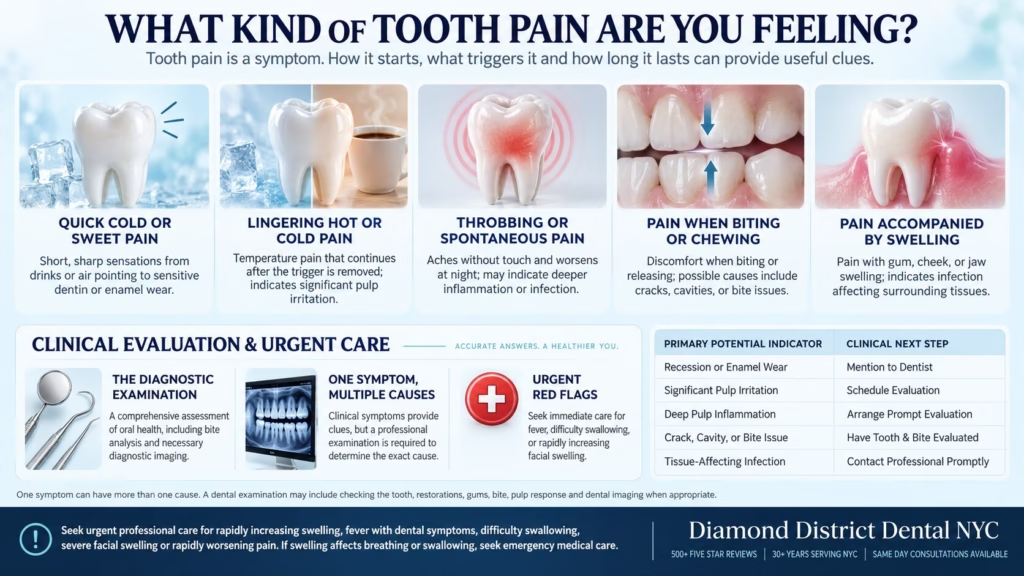
Tooth Pain Is a Symptom Pattern, Not a Diagnosis
Your dentist may need to check the tooth surface, restorations, bite, gums, pulp response and X-rays together to work out what is causing the pain.
Trigger matters
Cold, sweets, chewing and heat do not always point to the same part of the tooth.
Duration matters
Brief discomfort behaves differently from lingering or constant pain.
Swelling changes urgency
Pain with visible swelling often deserves faster professional evaluation.
POSSIBLE CAUSES
What Can Cause a Toothache?
Some causes involve the tooth surface, some involve the nerve inside the tooth, and others involve the supporting tissues or the bite.
The same toothache can start from very different structures.
A trigger or irritation occurs
Decay, temperature, chewing force, trauma, gum inflammation or a restoration issue.
The tooth or surrounding tissues react
The pain may come from dentin, pulp, root support, gums or neighboring structures.
The source has to be isolated
Clinical testing helps separate sensitivity, decay, cracks, bite problems and infection-related pain.
Cavities
Cavities & tooth decay Decay can expose deeper tooth layers, weaken the structure and eventually irritate the pulp.
Exposed dentin / sensitivity
Recession, enamel wear or other surface changes can make cold, sweets or air feel sharp and sudden.
Cracked or broken tooth structure
A crack, fractured cusp or chipped area may react to pressure, temperature or both.
Failing filling or crown
Older restorations can wear down, leak or fracture, leaving the tooth vulnerable to new irritation or pressure.
Pulp or root-area inflammation
Deeper tooth pain may involve the pulp inside the tooth or tissues around the root tip.
Gum or periodontal support
Gum inflammation, deeper pockets or reduced tooth support can create tenderness, pressure sensitivity or looseness.
Clenching, grinding or bite overload
Heavy bite forces can stress teeth, bruise supporting ligaments and make several teeth feel sore.
Food impaction, sinus pressure or referred pain
Sometimes the source is not obvious at first. Localized debris, upper sinus pressure or jaw-related referral can imitate tooth pain.
SENSITIVITY VS. TOOTHACHE
Tooth Sensitivity and Toothache Are Not Always the Same Thing
OFTEN MORE SURFACE-RELATED
It Zings With Cold, Then Stops.
A brief, sharp sensation that appears with cold, sweets, air or touch and fades quickly can fit a sensitivity-type pattern.
- Often starts with a specific trigger.
- Usually settles soon after the trigger is removed.
- May occur with exposed dentin, gum recession, enamel wear or localized irritation.
- Persistent or worsening sensitivity still deserves evaluation.
OFTEN A BROADER OR DEEPER PAIN PATTERN
It Aches, Throbs or Keeps Hurting.
Pain that lingers, starts without an obvious trigger, becomes throbbing or worsens at night may require a broader dental evaluation.
- Pain may continue after hot or cold is removed.
- It may begin spontaneously without eating or drinking.
- Biting pain, swelling or tenderness can point to another dental problem.
- The cause may involve decay, a crack, the pulp or surrounding tissues.
TOOTH PAIN EVALUATION
How Does a Dentist Figure Out Why the Tooth Hurts?
No single symptom or test explains every toothache. The diagnosis comes from putting several findings together.
NOTE:
Why more than one test may be needed: pain patterns can overlap. A single complaint such as “toothache” can involve sensitivity, decay, a crack, pulp inflammation, gum support, bite overload or a combination of problems.
Review the symptom story
What triggers the pain? Is it sharp, dull, throbbing, spontaneous, pressure-related or linked to swelling, trauma or recent dental work?
Check the teeth and restorations
The dentist looks for decay, exposed areas, fractures, filling or crown problems and other visible clues.
Test temperature, pressure and support
Cold testing, bite testing, percussion, mobility and periodontal evaluation may help clarify whether the tooth, pulp or supporting tissues are involved.
Use X-rays when clinically appropriate
Imaging can help assess decay depth, root conditions, bone support and other changes, but it is interpreted together with the rest of the exam.
Use imaging appropriate to the decision
Dental radiographs show bone levels; selected implant or graft cases may require CBCT to evaluate ridge dimensions, sinus position and nerve anatomy.
TREATMENT FOLLOWS THE CAUSE
How Is Tooth Pain Treated?
There is no one-size-fits-all treatment for a toothache. Care depends on what the examination shows.
SURFACE-RELATED DISCOMFORT
Sensitivity / Fluoride-Based Care
When symptoms fit a localized sensitivity pattern, the focus may be on reducing triggers and protecting exposed areas.
DECAY / STRUCTURAL REPAIR
Fillings or Restorative Care
When decay or a damaged area is identified, treatment may involve cleaning the area and rebuilding the tooth.
CRACK / HEAVY STRUCTURAL LOSS
Bone Grafting / Ridge Augmentation
Bone or bone-substitute material can be used as part of rebuilding a deficient ridge for selected implant or restorative plans.
PULP INVOLVEMENT
Root Canal When Clinically Needed
If the pulp is irreversibly inflamed or infected and the tooth is restorable, root canal therapy may be recommended.
GUM / SUPPORT PROBLEMS
Periodontal Treatment
When gum inflammation or loss of support is contributing to pain, care depends on the periodontal diagnosis and overall oral condition.
BITE OVERLOAD / CLENCHING
Bite & Night-Guard Discussion
If clenching, grinding or uneven pressure is involved, your dentist may discuss ways to reduce overload and protect the teeth.
You do not need to guess whether you need a filling, crown or root canal.
The right first step is finding out what type of tooth pain you are actually having.
WHILE YOU WAIT FOR AN EVALUATION
What Can You Safely Do at Home?
These steps are for temporary support only. They do not diagnose or permanently fix the cause of a toothache.
Safer temporary steps
- Avoid foods or drinks that clearly trigger the pain.
- If chewing makes it worse, chew on the opposite side when possible.
- Keep the area clean and rinse gently if food seems trapped.
- If swelling follows trauma, a cold compress on the outside of the face may help temporarily.
- General over-the-counter pain relief may help temporarily if used safely according to package directions and your own medical guidance.
What home care cannot fix
- It cannot close a crack or repair a broken tooth.
- It cannot permanently stop active decay beneath the surface.
- It cannot treat an infected or dying pulp.
- It cannot resolve a dental abscess on its own.
- It cannot permanently repair a leaking or failing filling or crown.
DON'T WAIT ON THESE SIGNS
When Is a Toothache More Urgent?
Some tooth pain can wait for a routine evaluation, while other symptoms deserve prompt attention especially when swelling, trauma or severe uncontrolled pain are involved.
Rapidly worsening pain or pain preventing sleep
Escalating pain, especially when it becomes spontaneous or intense, should be checked promptly.
Swelling in the gums, cheek, jaw or face
Visible swelling can indicate a more urgent dental or soft-tissue problem.
Fever, drainage or a puffy gum bump
These findings can occur with infection-related dental problems and deserve prompt professional evaluation.
Loose, displaced or injured tooth after trauma
Dental trauma can affect the tooth, root, ligament and surrounding bone even when damage looks limited.
Severe difficulty chewing or opening the mouth
If the pain and swelling are interfering with normal function, do not delay getting advice.
Difficulty swallowing or breathing?
If swelling is affecting breathing or swallowing, seek emergency medical care immediately.
MEET YOUR DENTIST
Experienced Care Starts with the Right Evaluation
Dr. Oleg Klempner brings more than 30 years of experience caring for patients throughout New York City. At Diamond District Dental NYC, every recommendation starts with a careful evaluation of your dental health, symptoms, and individual needs so you can understand what is happening and what your next step may be.
30+ Years
Serving NYC
NYU
College of Dentistry
Midtown
10 W 46th Street
Health First
Teeth, gums & bite
Common Questions
Questions Patients Ask About Toothaches
Throbbing pain can happen when deeper tooth tissues or surrounding areas are significantly irritated. It deserves evaluation, especially if it is spontaneous, worsening or keeping you awake.
Some patients notice stronger pain when lying down or when a problem has progressed enough to become more spontaneous. Night pain is a useful detail to tell your dentist.
Yes, deeper decay can become more painful over time. But constant pain is not caused only by cavities, so the tooth still needs evaluation.
It can. Symptom changes do not always mean the tooth has recovered, so important or recurring pain should still be checked.
Not automatically. Heat-triggered pain can be an important clue, but your dentist still needs to test the tooth and look at the full pattern before recommending treatment.
Yes, upper back teeth can sometimes feel sore when sinus pressure is involved. Dental causes still need to be considered, especially if the pain is localized or triggered by chewing or temperature.
Some temporary post-treatment soreness can occur. If the tooth feels high when you bite, the pain worsens, or symptoms last longer than expected, the filling and bite should be checked.
It can contribute to tenderness, pressure discomfort and soreness around teeth, especially when the supporting tissues are inflamed or reduced.
Cracks, bite overload, referred sinus pressure, deeper pulp irritation and other problems may not be obvious from appearance alone.
RELATED DENTAL CONCERNS
Other Dental Concerns That Can Overlap With Tooth Pain
This broad page helps patients move from a symptom to the more specific condition or service page that may be most relevant.
Tooth Sensitivity
For brief cold, sweet, air or temperature-triggered discomfort.
Pain When Biting
For chewing pressure, bite release pain or soreness with chewing.
Cracked Tooth
For suspected crack-related symptoms and structural pain patterns.
Broken / Chipped Tooth
For visible tooth damage, missing structure or sharp edges.
Cavities & Tooth Decay
For decay-related symptoms, sweet sensitivity or progressive tooth damage.
Gum Disease
For bleeding gums, gum tenderness, mobility or support-related concerns.
START WITH THE PATTERN
Not Sure Whether It Is Sensitivity, a Cavity, a Crack or Something Deeper?
A toothache can start from the tooth surface, the deeper pulp, a restoration, the gums, the supporting tissues or the bite. Start with an evaluation so the cause can be identified before you guess the treatment.