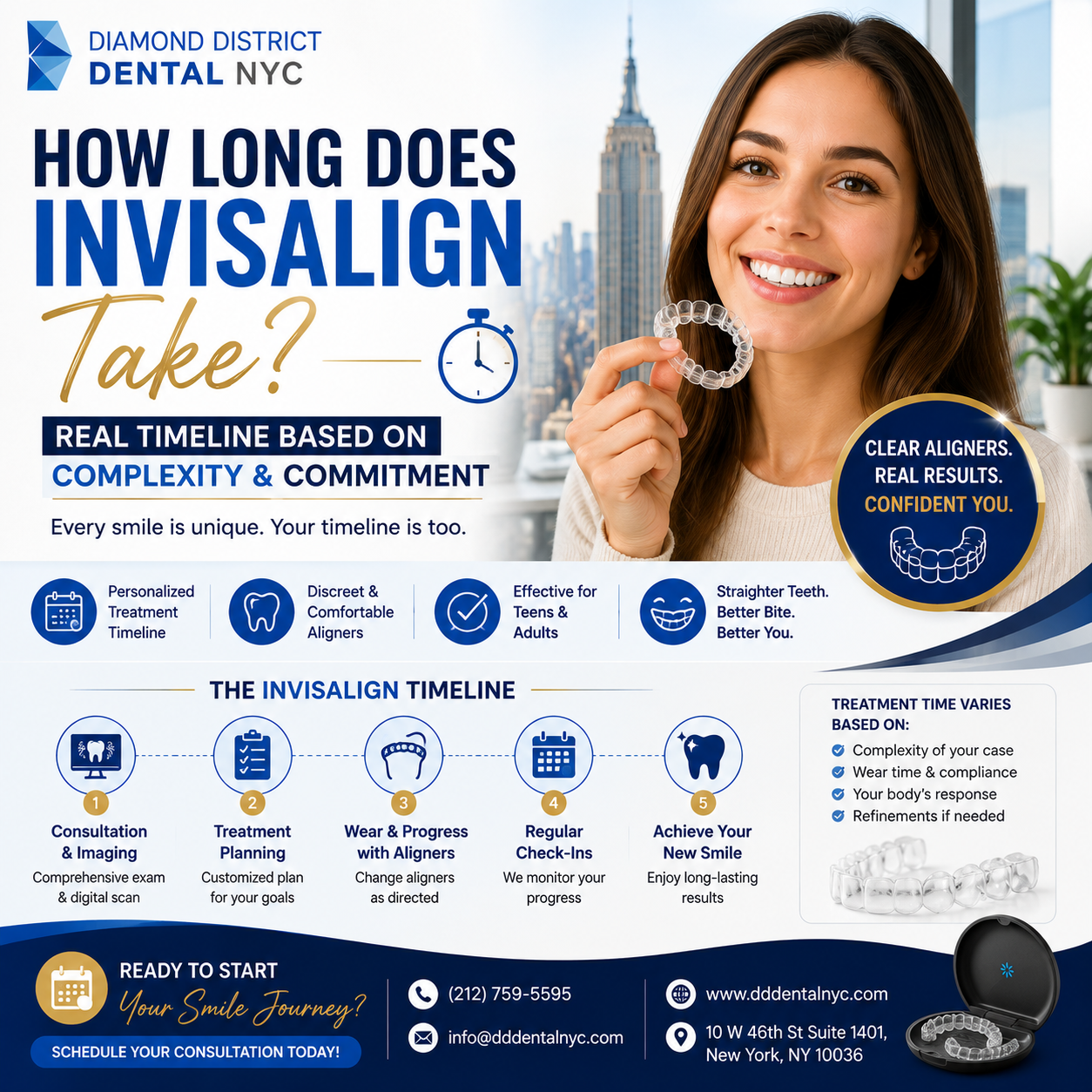
How Long Does Invisalign Take is one of the most common questions people ask before starting clear aligner treatment. While every smile is different, understanding the typical treatment timeline and the factors that influence it can help you set realistic expectations and make informed decisions about your orthodontic care.
How long does Invisalign treatment time usually take, and why do some people finish in months while others need longer?
That is one of the most common questions patients ask before starting clear aligner treatment. The honest answer is that Invisalign treatment time depends on several factors, including how complex the tooth movement is, how consistently aligners are worn, and whether the treatment plan is followed closely.
For some patients, Invisalign may take only a few months. For others, especially those with more significant crowding, spacing, or bite issues, treatment can take a year or more. A professional evaluation is the only reliable way to estimate your timeline.
At Diamond District Dental NYC, many adults and families in New York City want a discreet orthodontic option that fits into a busy schedule. Invisalign can be a strong choice for the right candidate, but the best results usually come from clear expectations, consistent wear, and regular monitoring.
What affects Invisalign treatment time?
There is no single timeline that applies to every patient. Invisalign treatment time varies because teeth do not all move at the same speed, and not every bite issue is equally simple to correct.
Several factors influence how long treatment may take:
- The amount of crowding or spacing
- Whether the bite is aligned properly
- If teeth need rotation or vertical movement
- How well the aligners fit and are worn
- Whether attachments, elastics, or refinements are needed
- The patient’s age and oral health
A person with mild spacing between front teeth may finish much faster than someone with crowding plus a deep bite or crossbite. That does not mean one case is better than another, only that the biology and mechanics are different.
A common misconception is that Invisalign is always faster than braces. In reality, speed depends more on case complexity and compliance than on the brand of appliance itself.
Typical Invisalign treatment time by case complexity
Most patients want a realistic range, not a vague promise. That is the right approach.
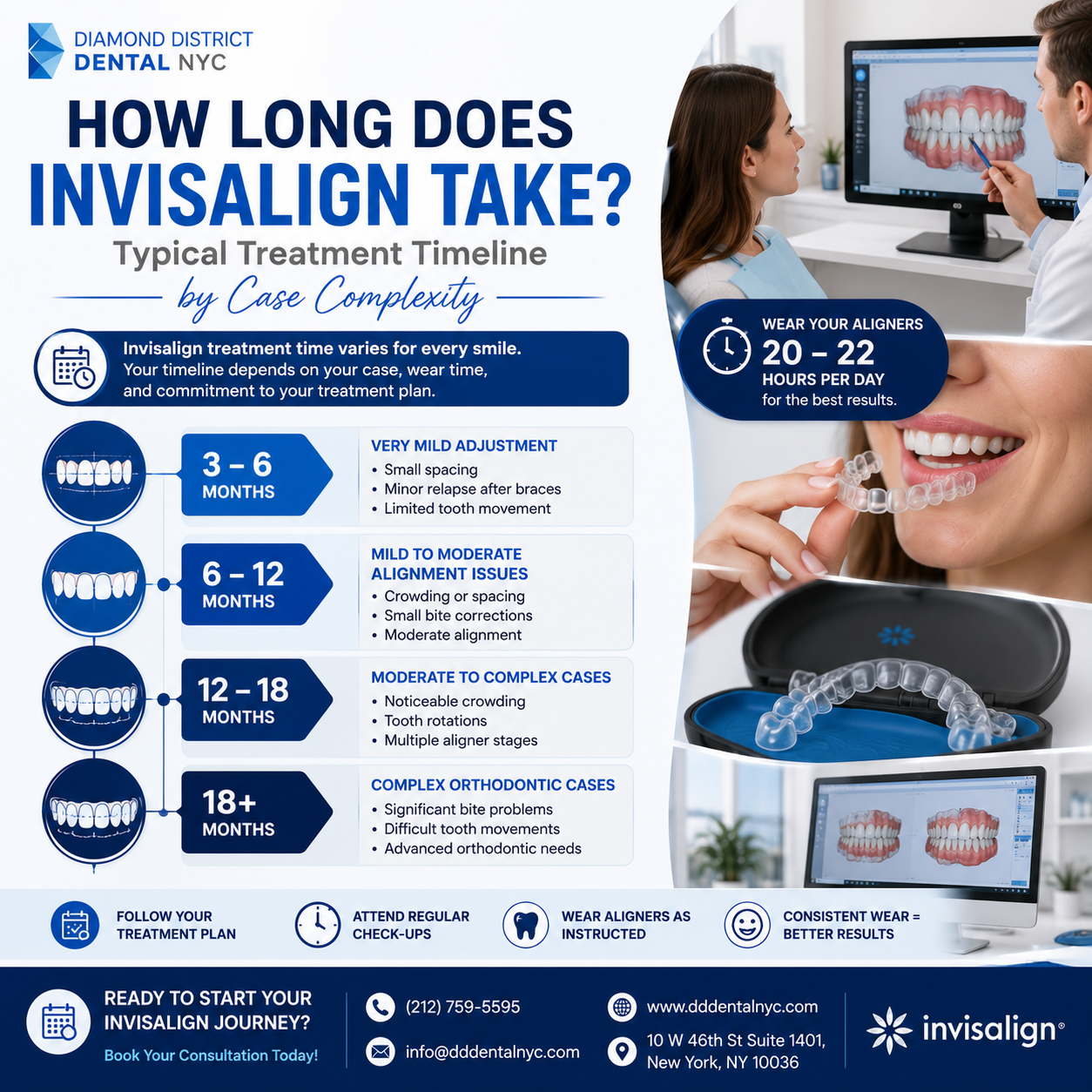
Here is a general overview of how Invisalign treatment time may vary:
Case Type | Typical Timeline | Common Examples |
Very mild adjustment | 3 to 6 months | Small spacing, minor relapse after braces |
Mild to moderate alignment issues | 6 to 12 months | Crowding, spacing, small bite corrections |
Moderate to complex cases | 12 to 18 months | More noticeable crowding, rotations, multiple aligner stages |
Complex orthodontic cases | 18 months or longer | Significant bite problems, difficult tooth movements |
These are general estimates, not guarantees. A dentist or orthodontic provider must evaluate your teeth, gums, bite, and jaw relationships before giving a more precise treatment estimate.
Why do some patients finish sooner?
Patients with smaller adjustments and excellent aligner compliance often move through treatment more efficiently. If the teeth only need limited repositioning, fewer aligners may be needed.
Why do some patients need more time?
Complex cases often require more planning and more stages of movement. In some situations, the dentist may recommend refinements after the first set of aligners to improve the final result.
How long does Invisalign take to work?
Can Invisalign work if you only wear the aligners part of the day? Usually not as well as it should.
The biggest patient controlled factor is wear time. Invisalign aligners are typically meant to be worn for about 20 to 22 hours per day, removing them only for eating, drinking anything besides water, and oral hygiene. If aligners are worn inconsistently, teeth may not move as planned.
- That can lead to:
- Slower progress
- Attachments not working as intended
- Aligners not fitting properly
- Need for extra refinements
- Longer overall treatment time
This is one reason dentists emphasize compliance from the beginning. Invisalign is convenient, but it is still an orthodontic treatment that depends on daily discipline.
A patient who wears aligners faithfully may finish on schedule, while another with the same starting case may need several extra months because the trays were not worn enough.
What happens during an Invisalign consultation?
A consultation is where the timeline becomes more personalized. This is especially important for patients searching for Invisalign treatment time in NYC and comparing different providers.
During an evaluation, the dentist may:
- Examine teeth, gums, and bite
- Take digital scans or impressions
- Review X rays if needed
- Check for cavities, gum disease, or other dental concerns
- Discuss the patient’s goals
- Estimate the expected duration of treatment
If a person has untreated decay or gum inflammation, those issues may need to be addressed before Invisalign begins. Healthy teeth and gums help support more predictable orthodontic movement.
Patients often appreciate that the consultation is not just about straightening teeth. It is also about making sure the teeth can be moved safely.
Can Invisalign be faster for adults?
Sometimes, yes. Adults often complete Invisalign successfully because they tend to follow instructions well and are motivated by cosmetic and functional goals. However, adult treatment is not automatically shorter.
Adult Invisalign treatment time may be affected by:
- Existing dental work
- Wear patterns on teeth
- Gum health
- Bone response to movement
- Prior orthodontic history
- Missing teeth or restorations
Adults in New York City often choose Invisalign because it is discreet in professional and social settings. That makes it especially appealing for people who want orthodontic treatment without the look of braces.
Still, the timeline should be based on clinical needs, not convenience alone.
How often are aligners changed?
Many Invisalign plans involve switching to a new set of aligners every 1 to 2 weeks, depending on the provider’s instructions and the treatment stage.
That said, aligner changes do not tell the whole story. Two patients might both change trays weekly, but one may need 14 aligners and the other may need 40 or more.
The number of trays is influenced by:
- How much movement is required
- Whether tooth rotations are involved
- Whether bite correction is needed
- How the teeth respond during treatment
If the teeth are moving as expected, the plan may stay on track. If not, adjustments may be necessary.
What can extend Invisalign treatment time?
Some delays are preventable, while others are part of normal treatment planning.
Common reasons treatment takes longer include:
- Missed wear time
- Lost or damaged aligners
- Missed follow up visits
- Poor oral hygiene leading to dental issues
- Teeth moving more slowly than expected
- Need for refinements
- Unexpected bite changes
Sometimes treatment is extended because the initial goal was more ambitious than the mouth could safely accomplish in the original plan. That is not a failure. It is often a sign that the provider is adjusting the treatment carefully.
What can make Invisalign go more smoothly?
A little consistency goes a long way.
Patients can often support a smoother Invisalign experience by:
- Wearing aligners the recommended number of hours each day
- Changing trays exactly as instructed
- Keeping aligners clean
- Storing them properly when removed
- Brushing and flossing regularly
- Keeping follow up appointments
- Reporting fit issues early
This kind of cooperation does not just help with speed. It also supports better final results.
Patients often compare Invisalign with braces because both can straighten teeth, but the best option depends on the case.
Factor | Invisalign | Traditional Braces |
Visibility | Clear and discreet | More visible |
Removability | Removable for meals and brushing | Fixed in place |
Hygiene | Easier to clean around teeth | Can be more challenging |
Compliance needed | High | Lower, since appliance stays on teeth |
Treatment time | Varies by complexity and wear | Also varies by complexity |
Best for | Mild to many moderate cases | Mild to complex cases |
In some situations, braces may be more predictable for certain complex movements. In other cases, Invisalign can be highly effective and more comfortable for the patient. A professional evaluation is the best way to decide.
Is Invisalign treatment time worth it?
For many patients, the answer is yes, especially if discreet treatment matters.
Common benefits include:
- Less noticeable appearance
- Removable trays for meals and oral care
- Fewer food restrictions
- Often more comfortable than metal brackets for some patients
- Helpful for adults with professional or social concerns
But Invisalign also has limitations:
- It requires strong compliance
- It is not ideal for every orthodontic case
- Results depend on proper monitoring
- Refinements may be needed
The question is not whether Invisalign is “better” for everyone. The better question is whether it is the right treatment for your teeth, bite, and lifestyle.
What if I only need a small correction?
Some patients do not need full orthodontic treatment. They may only want to correct minor spacing, slight relapse, or small alignment changes.
In those cases, Invisalign treatment time may be shorter, but only if the issue is truly limited. A dentist still needs to confirm that the concern is cosmetic or minor enough for a shorter plan.
It is also important not to skip evaluation just because the problem looks small. Even minor misalignment can sometimes reflect bite imbalance or other concerns that should be addressed properly.
Are results permanent?
Teeth can shift after treatment if retainers are not worn as instructed. That is true for Invisalign and braces alike. After active treatment ends, retainers are usually recommended to help maintain the new position of the teeth. Without retention, the teeth may gradually drift over time.
This is why treatment does not really end the day the last aligner is removed. Maintenance matters too. For patients searching for long term results, the retention phase is just as important as the active Invisalign timeline.
What affects the estimate most?
Factor | How It Influences Timeline |
Mild vs complex case | More movement usually means more time |
Wear time | More consistent wear supports on schedule progress |
Oral health | Cavities or gum problems may delay treatment |
Follow up visits | Monitoring helps catch issues early |
Refinements | Extra aligners can improve the final outcome but add time |
Age and biology | Teeth move at different rates in different patients |
Conclusion
Invisalign treatment time depends on the patient, the bite, the complexity of movement, and how closely the treatment plan is followed. Some people finish in months, while others need more time to reach a stable, healthy result. The most accurate timeline always comes from an in person evaluation, not a generic estimate.
For patients in New York City, it helps to work with a dental team that can evaluate both the cosmetic goals and the functional details behind the smile. That is the best way to understand whether Invisalign is a good fit and how long the process may realistically take.
Frequently Asked Questions
Most Invisalign treatments take 6 to 18 months, depending on the complexity of your case and how consistently you wear your aligners. Your dentist will provide a personalized treatment timeline.
Some minor alignment issues may improve in about 3 months, but most Invisalign treatments require more time. The exact duration depends on your smile goals and tooth movement needs.
No. Wearing your aligners for the recommended 20 to 22 hours a day helps keep treatment on schedule, but wearing them longer does not typically speed up tooth movement.
Not wearing your aligners as directed can delay tooth movement, affect the fit of future aligners, and extend your overall Invisalign treatment time.
It depends on your orthodontic needs. Invisalign may be faster for some mild to moderate cases, while traditional braces may be more effective for complex tooth or bite corrections.
No. Many patients benefit from Invisalign attachments because they help move teeth more precisely, but not every treatment plan requires them.
Possibly. Refinement aligners are common and help make small adjustments to achieve the best possible results, although they may slightly extend treatment time.
Yes, Invisalign can improve many mild to moderate bite issues, including overbites, underbites, and crossbites. More complex bite problems may require alternative orthodontic treatment or additional procedures.
If you are considering Invisalign treatment time and want a personalized estimate, schedule a consultation with Diamond District Dental NYC. Our team can evaluate your teeth, discuss your goals, and help you understand what timeline makes sense for your case.