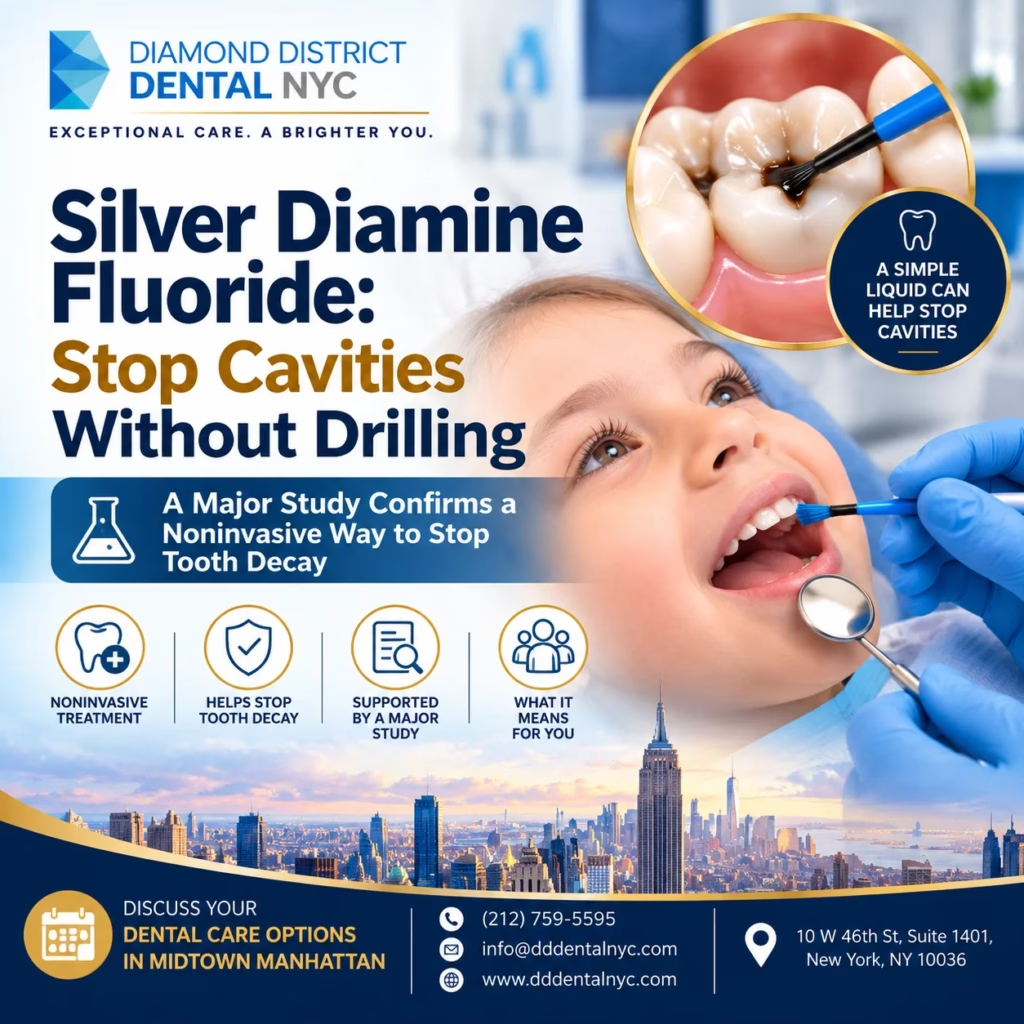
A cavity does not always mean a dental drill, an injection, or a filling. New clinical research is bringing renewed attention to a treatment that can help stop certain cavities from getting worse using a liquid applied directly to the affected tooth.
The treatment is called silver diamine fluoride, or SDF. A major clinical trial led by researchers at the University of Michigan found that this treatment stopped decay in more than half of the treated cavities in young children when applied at six month intervals. The findings, published in JAMA Pediatrics, could help expand the role of minimally invasive cavity management in appropriate patients.
For families concerned about dental treatment, this research raises an important question: Can a dentist stop a cavity without drilling?
The answer is sometimes yes. However, the right treatment depends on how far the decay has progressed, which tooth is affected, and the patient’s overall dental health. Understanding what silver diamine fluoride does, what the research shows, and where its limitations lie can help patients make informed decisions about their care.
What Is Silver Diamine Fluoride?
Silver diamine fluoride is a topical dental treatment that dentists can apply directly to an area of tooth decay. It is commonly abbreviated as SDF and is used as a minimally invasive option for managing certain cavities.
Unlike a traditional filling, SDF does not require the dentist to drill away the decayed area before applying the treatment. Instead, the dentist places a small amount of the liquid on the affected tooth using a specialized applicator.
The treatment combines the properties of silver and fluoride.
Silver helps combat bacteria associated with tooth decay. Fluoride supports the tooth’s mineral structure and helps it resist further mineral loss. Together, these effects can help slow or arrest the progression of selected cavities.
The procedure itself is relatively quick. Depending on the patient’s needs, the dentist may recommend additional applications and follow up examinations to determine whether the decay remains inactive.
The American Dental Association’s overview of silver diamine fluoride explains how the treatment can be used as part of a dentist supervised cavity management plan.
It is important to understand that SDF does not replace the missing portion of a tooth. If a cavity has removed a significant amount of tooth structure, additional restorative treatment may still be necessary.
What Did the Major Clinical Study Find?
The recentresearch received attention because it examined silver diamine fluoride in a large group of young children with severe early childhood tooth decay.
The Phase III clinical trial enrolled 830 children younger than six years old. Researchers from the University of Michigan worked with collaborators from New York University, the University of Iowa, and Indiana University.
The study evaluated a 38% silver diamine fluoride solution and compared its effects with a placebo treatment. The children received treatment at the beginning of the study and again six months later, with dental examinations during the follow up period.
The results showed that silver diamine fluoride stopped decay in more than half of the treated cavities. The placebo group had a substantially lower rate of decay arrest.
The study was published in JAMA Pediatrics under the title Efficacy of Silver Diamine Fluoride on Young Children With Severe Early Childhood Caries.
You can read the research summary from the National Institutes of Health or review the original publication through its journal DOI
What Do the Findings Mean?
The findings provide strong clinical evidence that silver diamine fluoride can help arrest certain cavities in young children.
For families, this may mean that a cavity can sometimes be managed without immediately proceeding to conventional restorative treatment. It may also offer an option for children who find longer dental procedures difficult.
However, the study should not be interpreted as proof that every cavity can be treated without drilling. The research focused on young children with severe early childhood caries, and the results do not establish that SDF is the best option for every age group, every tooth, or every stage of decay.
The study also does not mean that patients can stop attending dental appointments after receiving the liquid. Follow up examinations remain important for checking whether the treatment has successfully arrested the decay.
How Can a Liquid Help Stop a Cavity?
To understand why silver diamine fluoride works, it helps to understand how cavities develop.
Tooth decay occurs when bacteria in dental plaque use sugars from food and drinks to produce acids. These acids gradually remove minerals from the tooth surface. If the process continues, the damage can extend into deeper tooth layers and form a cavity.
Silver diamine fluoride helps interrupt this process through several mechanisms.
1. It Helps Control Cavity Causing Bacteria
Silver has antimicrobial properties that help reduce the activity of bacteria associated with tooth decay. This can help make the affected area less favorable for continued decay.
2. It Supports the Tooth's Mineral Structure
Fluoride helps strengthen the mineral structure of teeth and supports resistance to further mineral loss. SDF can also help harden previously softened areas of decayed dentin.
3. It Can Help Arrest Existing Decay
When the treatment works as intended, the affected area becomes harder and the decay stops progressing. Dentists call this process caries arrest.
This distinction matters because a cavity can become inactive without returning to its original shape. The treatment may control the disease process, but it does not automatically rebuild tooth structure that has already been lost.
For more information about evidence based cavity management, the American Dental Association’s caries management guidelines explain how treatment recommendations vary according to the type and location of a lesion.
Can Silver Diamine Fluoride Stop Every Cavity Without Drilling?
No. Silver diamine fluoride is a useful option in selected situations, but it is not a universal replacement for fillings, crowns, or other restorative procedures.
Whether SDF is appropriate depends on the extent of the decay, the location of the cavity, the condition of the tooth, and the patient’s individual circumstances.
A dentist must examine the tooth and determine whether the affected area can be managed with a nonrestorative treatment or requires a procedure to restore its structure.
When SDF May Be Considered
A dentist may consider silver diamine fluoride for certain cavities in baby teeth, particularly when a child is very young or has difficulty tolerating conventional treatment.
It may also be useful for some older adults, patients with special healthcare needs, or individuals for whom more extensive dental treatment is temporarily difficult.
In some cases, SDF can serve as an interim approach while the patient prepares for a filling or another restorative procedure.
The American Academy of Pediatric Dentistry recognizes SDF as a minimally invasive option that may prevent or delay more extensive treatment when used as part of an individualized cavity management plan. Its recommendations are available in the AAPD policy on silver diamine fluoride for pediatric dental patients
When Additional Dental Treatment May Be Needed
If decay has destroyed a substantial amount of the tooth, the patient may need a filling or crown to restore its shape and function.
If the decay has reached the inner pulp tissue and caused significant inflammation or infection, SDF alone may not be sufficient. Depending on the diagnosis, treatment could involve a root canal or another procedure.
Patients experiencing persistent tooth pain, swelling, or signs of infection should not delay dental assessment while searching for a treatment that avoids drilling.
Diamond District Dental explains the role of restorative care in its guide to general dentistry in Midtown Manhattan. Patients who want to understand more advanced treatment can also read the practice’s article, What Is a Root Canal?
The purpose of a dental examination is to identify the condition of the tooth and determine which treatment is most likely to protect it.
What Is the Main Disadvantage of Silver Diamine Fluoride?
The most noticeable disadvantage of silver diamine fluoride is that it can permanently turn the decayed portion of a treated tooth dark or black.
This discoloration is a result of the treatment’s interaction with the affected tooth structure. It is not simply a surface stain that can be brushed away.
For some families, this may be an acceptable trade off when treating a cavity in a baby tooth, especially if the alternative involves a more difficult procedure. For adults, or when the affected tooth is visible while smiling, the change in appearance may be a significant concern.
SDF may also produce an unpleasant taste and can irritate the gums or other soft tissues if it comes into contact with them. Application should therefore be performed by a qualified dental professional who can assess the tooth, explain the potential side effects, and take appropriate precautions.
Before agreeing to treatment, patients and parents should understand:
- Whether the treatment is suitable for the particular cavity.
- How the treated area may look afterward.
- Whether additional applications are likely to be needed.
- How the dentist will monitor the tooth.
- Whether a filling or another restoration may still be required.
ADA’s clinical information on SDF provides further details about its benefits, limitations, and use in dental care.
Is Silver Diamine Fluoride Approved by the FDA for Cavities?
This is an important distinction in understanding the research.
In the United States, silver diamine fluoride products have FDA clearance for treating tooth sensitivity. Using SDF to arrest cavities is an off label use, meaning the product is being used for a purpose that is not included in its specific FDA cleared indication.
The recent clinical trial provides important evidence supporting the use of SDF for cavity management in young children. Researchers have indicated that the findings could support efforts to seek FDA approval for this specific use.
However, evidence from a clinical trial and regulatory approval are not the same thing. The publication of the study does not, by itself, establish that the FDA has approved SDF as a cavity treatment.
Patients should ask their dentist about the treatment’s intended use, expected benefits, limitations, and available alternatives.
This distinction also matters when considering insurance coverage and the availability of products. Coverage and reimbursement may vary, so patients should confirm the details with their dental office and insurer.
How Does SDF Compare With a Traditional Filling?
Both treatments can play an important role in cavity management, but they work differently.
Consideration | Silver Diamine Fluoride | Traditional Filling |
Main purpose | Helps arrest selected cavities | Restores tooth structure after decay is managed |
Drilling | Usually not required for SDF application itself | Often required to prepare the tooth |
Replaces missing tooth structure | No | Yes |
Treatment time | Application is usually quick | Depends on the cavity and restoration |
Appearance | May permanently darken the decayed area | Tooth colored fillings can blend with natural teeth |
Follow up | Monitoring and possible repeat application are important | The restoration also requires routine dental monitoring |
Suitability | Depends on the cavity and individual needs | Depends on the extent and location of damage |
Neither option is automatically better for every patient.
SDF may be appropriate when the priority is to arrest decay with a minimally invasive approach. A filling may be more suitable when the tooth needs its shape, strength, or function restored.
A dentist can explain which approach fits the condition of the tooth and whether combining treatments may be appropriate.
Can Adults Benefit From Silver Diamine Fluoride?
Yes. Although the recent major trial focused on young children, SDF may also be considered for selected adult patients.
For example, it may help manage certain root cavities in older adults, particularly when exposed root surfaces are difficult to keep clean. It may also be useful for patients who have difficulty tolerating conventional restorative treatment or who need an interim approach before more comprehensive care.
However, the findings from the trial involving children should not be applied automatically to every adult cavity. Adult teeth, root surfaces, existing restorations, and individual health conditions may create different treatment considerations.
Adults should discuss the expected results, possible discoloration, alternatives, and monitoring requirements with their dentist before choosing SDF.
What Does This Research Mean for Patients in NYC?
The research highlights an important development in modern dentistry: not every cavity must automatically be approached with the same procedure.
Minimally invasive treatment options can give dentists more ways to manage decay, particularly when a patient may benefit from avoiding or delaying a more involved procedure.
For patients in New York City, the most useful next step is not to assume that a liquid treatment will replace every filling. It is to have a dentist examine the tooth, explain the extent of the decay, and discuss the options supported by the clinical findings.
At Diamond District Dental, patients can discuss concerns about cavities, preventive care, and restorative treatment with the dental team. A personalized assessment can help clarify whether a nonrestorative approach is appropriate or whether a filling or another procedure is needed.
If you have noticed tooth sensitivity, a visible dark spot, discomfort while chewing, or another possible sign of decay, arranging an examination can help identify the problem before it becomes more extensive.
You can learn more about the practice’s general dentistry services or contact Diamond District Dental to arrange an appointment
Conclusion: A Promising Option, Not a Universal Replacement for Fillings
Silver diamine fluoride is an important option in minimally invasive dentistry, and the recent clinical trial provides substantial evidence that it can stop certain cavities from progressing in young children.
Its quick application and ability to manage selected areas of decay without drilling may help some patients avoid or delay more involved procedures. At the same time, permanent dark staining, the need for follow up monitoring, and the possibility of additional restorative treatment must be considered.
The main lesson from the research is that cavity treatment should be based on the condition of the tooth rather than the assumption that every cavity needs the same procedure.
If you are concerned about tooth decay, a dental examination can help you understand the available options and choose a treatment plan suited to your needs.
Frequently Asked Questions
The liquid is called silver diamine fluoride, or SDF. A dentist applies it directly to selected areas of tooth decay to help stop the decay from progressing. It does not replace missing tooth structure, and some cavities still require fillings or other treatment.
Clinical research supports the use of SDF to arrest certain cavities. In a major trial involving 830 children younger than six, 38% SDF stopped decay in more than half of the treated cavities when applied at six month intervals. Results vary, and professional monitoring is necessary.
Applying SDF directly to a suitable cavity generally does not require drilling or an injection. However, if the tooth has extensive damage or needs additional treatment, a dentist may recommend a filling, crown, or another procedure.
Yes. SDF can permanently darken the decayed portion of the tooth it treats. This is one of its main disadvantages and should be discussed before treatment, especially when the cavity affects a visible front tooth.
It may be suitable for selected adults, including some patients with root cavities or difficulty tolerating conventional treatment. However, the recent major clinical trial focused on young children, so its results should not be assumed to apply equally to every adult patient.
In the United States, SDF products have FDA clearance for treating tooth sensitivity, while cavity arrest has been an off label use. The new clinical evidence may support a request for approval for cavity treatment, but publication of the study alone does not mean that such approval has been granted.
Possibly, but not in every case. SDF can help arrest selected cavities, but it does not restore the part of a tooth that has already been lost. Your dentist must assess the cavity and determine whether monitoring, repeat treatment, a filling, or another procedure is appropriate.
A dental examination is the first step. Your dentist can assess the cavity’s depth and location, explain the benefits and disadvantages of SDF, and compare it with other treatments. Contact Diamond District Dental NYC to arrange an appointment.